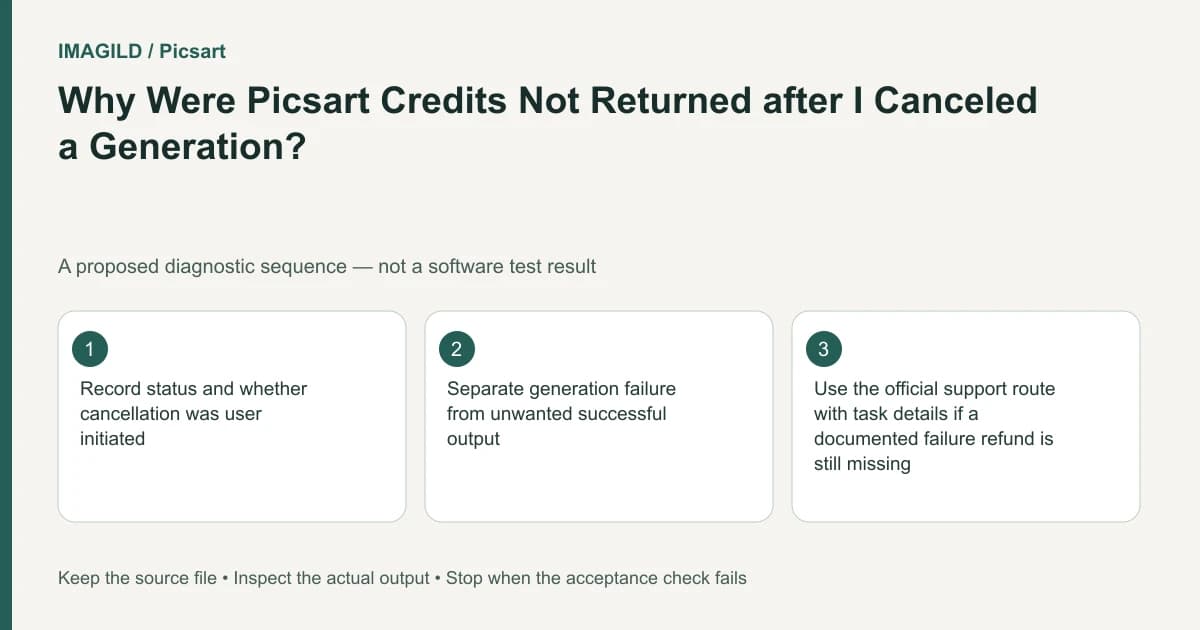
Classify the Playground job before expecting credits to return. A service-reported failure, a user cancellation and a successful result you dislike follow different documented rules. Check the actual outcome, then the return condition and elapsed time; do not cancel a pending job merely to test reimbursement.
Read the job outcome first
The Playground introduction says failed generations receive an automatic credit return, usually quickly but sometimes taking up to 24 hours. It distinguishes user cancellation and a successful unwanted result, which do not receive that same automatic return.
Use the observed status, not a feeling that the picture is wrong:
| Observed job outcome | Documented return condition | Next action |
|---|---|---|
| Generation failed | Automatic return; sometimes up to 24 hours | Record failure time and inspect the corresponding return |
| User cancelled the generation | Not covered by the same automatic-return rule | Keep it classified as cancellation; do not label it service failure |
| Generation succeeded but output is disliked | Not covered by that automatic-return rule | Treat as a creative rejection, not missing service output |
| Still processing or status unknown | Failure not yet established | Find the existing job/status before another submission |
| Confirmed failure, return still absent after 24 hours | Provider support review is the documented next route | Supply the relevant request and balance evidence privately |
The AI video failure guide supplies the 24-hour support route for failed video requests. Do not replace it with a guarantee that every account dispute is refunded.
Track separate requests separately
In a hypothetical session, request A reports failure at 14:00, request B is cancelled by the user and request C completes with the wrong color. At 15:00, only A is in the documented failed-job return category, and the longer stated return window has not yet elapsed. Those times illustrate the rule; they are not an observed account transaction.
Make one row per actual request: model, submission time, displayed cost, final status and any return observed. If no identifier is shown, use enough settings and timing detail to distinguish the requests. Do not infer which job was returned only from a net balance after several new runs.
The points and job guide provides a general request-recording framework. Its Imagild-specific accounting rules are not Picsart reimbursement rules.
Distinguish a closed page from a failed job
A local progress screen disappearing does not establish a service failure. Reopen the same account and locate the existing creation or job state. A server-side request can have an outcome independent of the browser's current view.
The abort-is-not-cancellation explanation illustrates that conceptual difference in another API. Do not import its implementation or billing behavior into Picsart. For this account, use Picsart's actual status and the rules cited above.
If a returned result exists, verify whether it is the completed media from that request. The sharing and download guide explains obtaining the creation file. A completed but unattractive file remains a different event from a request that returned no video.
The preview-versus-export check helps when a playable online result and a downloaded file differ. Such a delivery mismatch should not silently be reclassified as a failed generation without checking the actual job record.
Escalate an unresolved failed-job return
When a confirmed failed video has no expected return after the documented period, provide support with the tool, model, error message, approximate request/failure time and relevant balance evidence. Keep the original failure distinct from any later retry. Do not send passwords, access tokens or unrelated personal photos.
If the observed state remains uncertain, describe that uncertainty instead of asserting either success or a refund. Repeated paid submissions make reconciliation harder and do not prove the first job failed.
Completion means each request is correctly classified and any unresolved qualifying return has the necessary evidence for support. The table is documentation-based guidance, not a performed refund test or a promise about support's decision in a particular case.
Prepared by Imagild Editorial. AI assisted research and drafting. Documentation checked on 4 November 2026; examples and checks above are proposed, not claims of hands-on software testing. Report a correction.