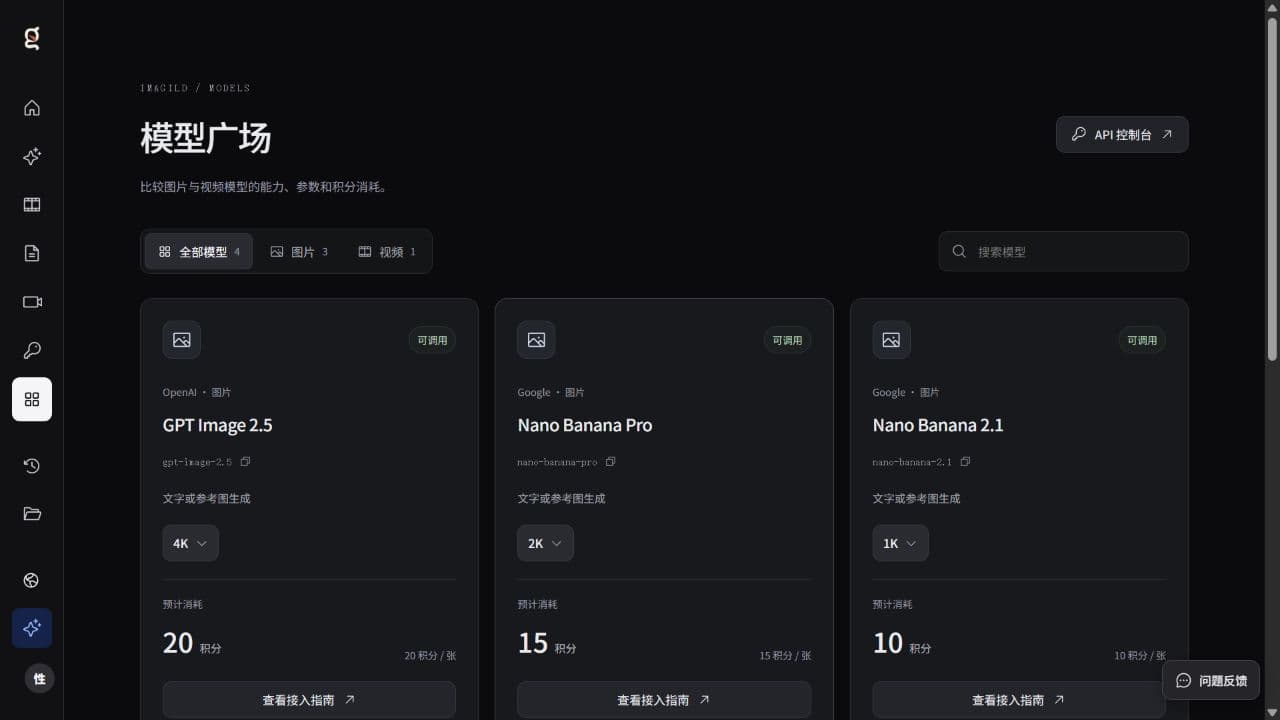
Budget an Imagild H3 video as requested seconds multiplied by the selected resolution's rate, plus five points if context_ir is enabled. Add any separately generated reference image and explicitly planned retake. Keep membership outside the generation subtotal, because points alone do not unlock API access.
The current model hub lists 768P at 15 points per requested second and 2K at 30. One API task accepts an integer duration from 4 through 15 seconds.
Key Takeaways
- Calculate duration, resolution and enhancement before authorizing a video request.
- A generated reference image is a separate task; an already approved reference need not be generated again.
- Budget a creative retake separately from recovery of an uncertain submission.
Start with a shot-level calculation
For a single video, use:
video points = seconds × resolution rate + enhancement surcharge
enhancement surcharge = 5 when context_ir is true; otherwise 0
This table includes one new 1K reference image and one possible additional video generation. It assumes all listed generations succeed; it is a production allowance rather than a failure-refund prediction.
| Plan | First video | New 1K still | One same-setting retake | Total allowance |
|---|---|---|---|---|
| 4s, 768P, IR off | 60 | 10 | 60 | 130 |
| 8s, 768P, IR on | 125 | 10 | 125 | 260 |
| 8s, 2K, IR on | 245 | 10 | 245 | 500 |
For the middle row, the first video is 8 × 15 + 5 = 125. A revised video with the same settings costs another 125 points if generated successfully. Reusing the approved still through image_task_id does not submit a second image-generation request.
A reference you upload yourself is a different source path. Do not add a hypothetical model-generated still unless your actual plan includes one.
Separate requested seconds from usable seconds
A successful eight-second generation does not guarantee eight usable edited seconds. The subject might leave the frame, an ending might need trimming, or the motion might not match the brief. Judge the complete saved clip before treating it as finished campaign footage.
Do not divide a campaign budget by the best-looking two-second excerpt and present that as the provider's generation rate. The request was for eight seconds, even if the editor later keeps less.
The already-moving first-frame guide helps identify an action-planning issue that a larger resolution alone will not repair.
Present the approval in plain language
A useful confirmation says: “One eight-second 768P generation with enhancement: 125 points. Optional separately approved retake: another 125. New 1K source still: 10.” This is more informative than one unexplained maximum.
Show which choices changed if a user selects 2K or adds another shot. Require approval for the revised plan before submission. Four or fifteen seconds remain separate settings; neither a valid account key nor a previous approval establishes permission for an expanded batch.
Runware's rate explanation also connects generation units to configuration. Its units and account features should not be copied as Imagild fields. Send only the supported body shown in the Imagild API console; there is no caller-defined price field.
Reconcile outcomes without assuming every retry costs again
If a submission's network response is lost, preserve its original Idempotency-Key and unchanged parameters. That is recovery of the same operation. A deliberate creative retake has changed intent and receives a new operation identity.
When a video reports unknown, retain the existing task for reconciliation rather than immediately spending its retake allowance. A confirmed failed generation releases its reservation under the existing rules, but no cash-refund timing is inferred.
Finally, compare saved usage.points and usage.state with this approved shot plan. The points planning guide helps explain the shared wallet. Membership cost and activation remain separate, as do any external editing, taxes and applicable checkout terms.
Related tasks
- How Can My AI Clip Start in Motion Instead of Spending Seconds Accelerating?
- Imagild Points, Resolution and Jobs: Plan a Creation Before You Spend
Sources and scope
- Imagild API console: Current active-member access, generation contract and per-task usage fields, independently cross-checked in lib/relay and claims.json dated 2026-10-28.
- Imagild model hub: Current image 10/15/20-point tiers, H3 duration/resolution rates and five-point enhancement option; not a quality or comparative availability benchmark.
- Runware Pricing: General distinction between configuration-based generation pricing, per-request cost and account payment management. Runware-specific fields, features and policies are not attributed to Imagild.
Product instructions were checked against the current Imagild API contract and the public model catalog. Code, budgets and acceptance checks are illustrative; this article does not claim a new paid generation test, an uptime measurement, a search-volume study or a ranking of AI citations.
Prepared by Imagild Editorial, the company editorial team responsible for these guides. AI assisted research and drafting. This is documentation-based guidance with proposed examples, not a claim of hands-on testing or an independent product review. Report a correction.
Cover: Original Imagild product screenshot captured on 28 October 2026; model availability and prices may change. This image is not an API response or a performance benchmark.