An Imagild video task marked unknown has an unresolved upstream outcome. It is not a confirmed failure, a completed clip, or permission to create another paid attempt. Preserve the same operation and task IDs, inspect the saved usage state, and ask for reconciliation with sanitized evidence.
This state exists to avoid pretending that an ambiguous provider receipt proves no work occurred. The Imagild API console remains the product reference for task access; your application's recovery policy should make uncertainty visible.
Key Takeaways
- Treat
unknownas a review state rather than relabeling it failed. - Do not replace the idempotency key, switch models, or submit a second clip automatically.
- Keep a support packet that identifies the operation without exposing its Bearer key or private media.
Recognize uncertainty in the actual response
The current task record uses data.status and data.usage.state. For an unresolved video result, data.error.code can be UPSTREAM_RESULT_UNKNOWN. The output URL is absent until success is reported.
A reduced illustrative record looks like this:
{
  "data": {
    "id": "11111111-1111-4111-8111-111111111111",
    "status": "unknown",
    "usage": {"points": 60, "state": "reserved"},
    "error": {"code": "UPSTREAM_RESULT_UNKNOWN"}
  }
}
The example assumes a four-second 768P H3 task without enhancement, which is currently 60 points. Your real task's quote and usage may differ. Read them from its record rather than forcing these example numbers into your billing view.
Stop the actions that can multiply the problem
Disable automatic creative fallback for this operation. A fallback that generates a different video under a new identity can leave two paid operations to reconcile. Repeating an unknown operation with the same key does not establish a free retry or guarantee that ambiguity disappears.
Also avoid changing an unknown record's local status to failed just to clear a queue. A useful application label is “Outcome needs checking,” with the original task ID available in an authorized detail view.
Async systems commonly separate acknowledgment from result retrieval, as Runware's polling reference illustrates. That general pattern does not establish Imagild's ability to cancel or restart a provider task.
Build a support packet that is useful and safe
| Include privately with your support request | Exclude |
|---|---|
| Imagild task ID and your operation identifier | API key or complete Authorization header |
| First submission time and timezone | Account password or login codes |
| Requested model, duration and resolution | Unnecessary private reference photos |
| Latest observed status, usage state and safe error code | Raw provider responses or routing secrets |
| A request_id if an HTTP error response supplied one | Entire logs containing unrelated customers |
A task-level error object does not necessarily contain a request ID. Do not invent one or confuse your application's internal trace ID with a provider-issued value.
Describe what your application already did: one submission, a lost response, later GETs, or a local deadline. This makes it easier to distinguish a connection problem from a reported upstream uncertainty.
Recheck without promising automatic resolution
An authorized GET /tasks/{id} can inspect the owned task again. Keep reads bounded and spaced; active membership and a valid key remain required. Do not run an endless fast polling loop while waiting for support.
An unknown task may require review beyond what another GET can determine. The API state is not a promise of a reconciliation deadline or of automatic immediate point release. If a later observation reports success, validate and download that existing output. If a confirmed failure is established, inspect the released reservation state rather than generating first and investigating later.
For context, see the failed-job next-action checklist and points planning guide. Neither a support message nor a local status change should itself be treated as a new billing transaction.
Verify your uncertainty branch locally
Feed your application a fixture with unknown status and reserved usage. Check that the card stops claiming progress, hides download, preserves IDs and prevents an automatic replacement POST. Then reload the view and confirm the review state survives. This test costs no generation points and verifies the behavior that matters most: uncertainty does not silently create more work.
Related tasks
- What Should You Check Before Retrying a Failed Image or Video Job?
- Imagild Points, Resolution and Jobs: Plan a Creation Before You Spend
Sources and scope
- Imagild API console and integration guide: Current Imagild entry point, active-member access, asynchronous task reading and authenticated output contract; implementation facts cross-checked in lib/relay and the 2026-10-28 claims manifest.
- Runware Task Polling: General asynchronous acknowledgment/result separation and spaced polling. Runware-specific task shapes, partial results, SDKs and webhooks are not attributed to Imagild.
- Imagild model hub: Current image resolution point rates and H3 video point schedule; no uptime, comparative price rank or output quality guarantee is inferred.
Product instructions were checked against the current Imagild API contract and the public model catalog. Code, budgets and acceptance checks are illustrative; this article does not claim a new paid generation test, an uptime measurement, a search-volume study or a ranking of AI citations.
Prepared by Imagild Editorial, the company editorial team responsible for these guides. AI assisted research and drafting. This is documentation-based guidance with proposed examples, not a claim of hands-on testing or an independent product review. Report a correction.
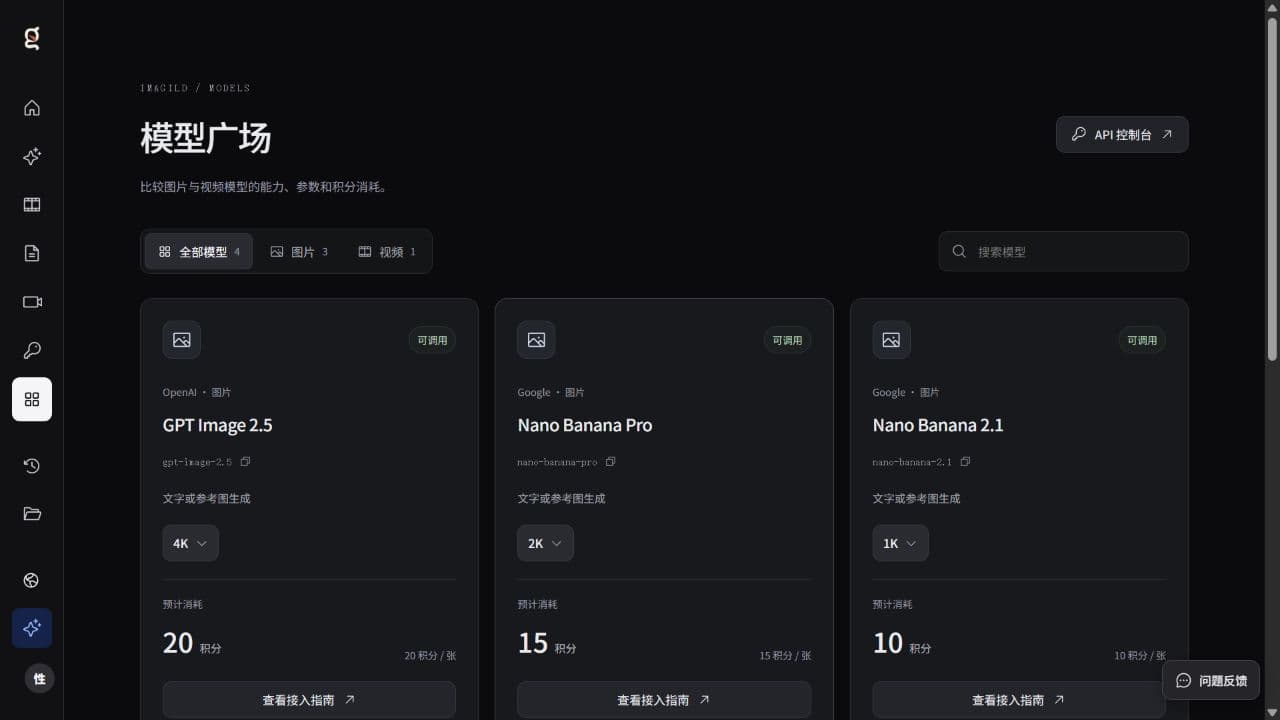
Cover: Original Imagild product screenshot captured on 28 October 2026; model availability and prices may change. This image is not an API response or a performance benchmark.