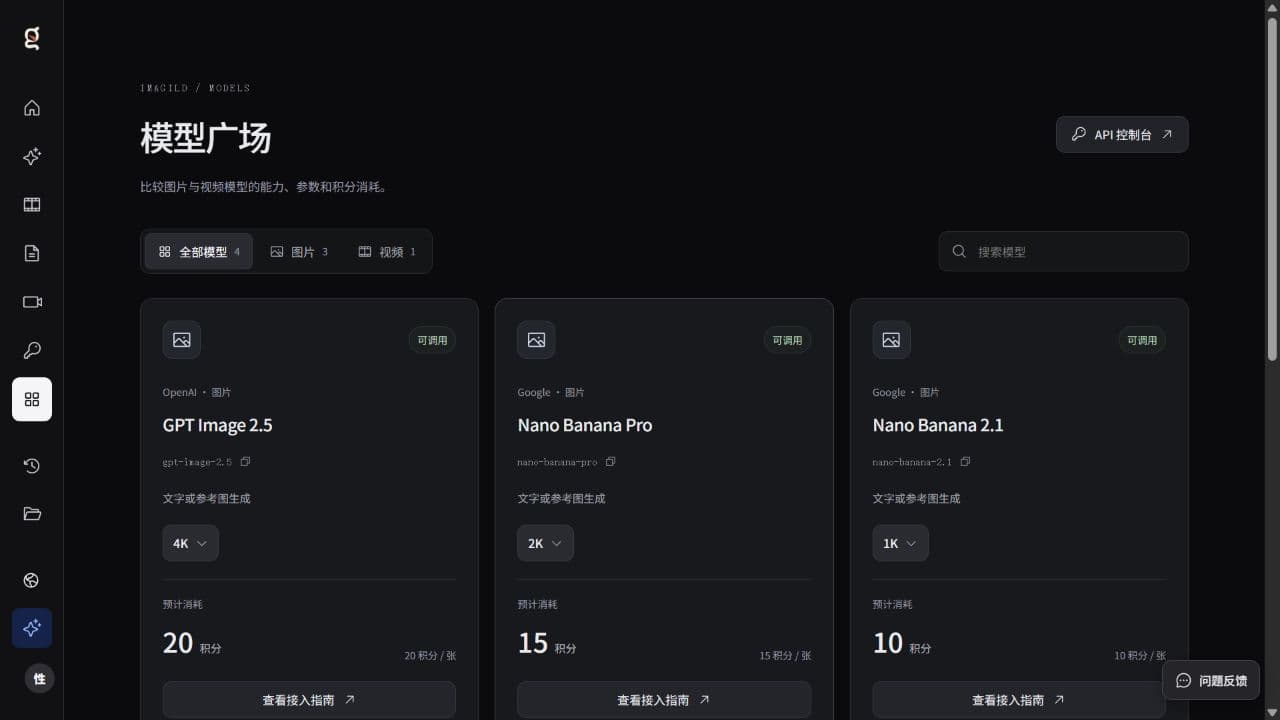
Yes. You can generate an Imagild API image from a text prompt without uploading a photograph. Send a model, a nonempty prompt, and a resolution tier to POST /images/generations. Omit both reference selectors. The response accepts an asynchronous task; it does not immediately contain a ready-to-publish image.
Key Takeaways
- Text-only generation needs no placeholder upload,
file_id, orimage_task_id.- A trimmed text-only prompt must contain 1–4,000 characters.
- Save
data.id, poll that task, and download its result only after success.
Use the smallest request that describes the scene
Before running the example, create a key in the Imagild API console. Active membership is required, and generation uses the account's existing points. A 1K image currently costs 10 points; verify current choices in the model market.
Keep the key in a backend environment variable. Replace the operation key below for a genuinely new image, but retain it when retrying the same request after an uncertain connection result.
curl --fail-with-body \
  'https://imagild.com/api/relay/v1/images/generations' \
  -H "Authorization: Bearer $IMAGILD_API_KEY" \
  -H 'Content-Type: application/json' \
  -H 'Idempotency-Key: ceramic-vase-concept-0001' \
  -d '{
    "model": "gpt-image-2.5",
    "prompt": "A matte blue ceramic vase on a pale stone plinth, soft window light from the left, empty neutral background, editorial product photograph.",
    "resolution": "1K"
  }'
Do not add inputMode, kind, image_url, or a fabricated empty reference. This endpoint derives text generation from the absence of a reference selector. Unsupported fields are rejected by its strict JSON contract.
The other current canonical image choices are nano-banana-pro and nano-banana-2.1. Select an available ID from GET /models; the model string is not proof of compatibility with another vendor's SDK.
Write a prompt that can be reviewed
A useful first prompt states the subject, setting, composition, and lighting. For this example, the acceptance condition is a single blue vase, a clear plinth, soft light from the left, and an uncluttered background. Those conditions make the result reviewable without depending on unspecified camera jargon.
If an image needs visible wording, supply that wording explicitly and inspect it in the output. Do not infer that selecting 4K guarantees correct letters. If a layout must meet exact dimensions, plan a downstream layout step and verify the decoded image rather than treating the tier name as a pixel specification.
Text generation and reference editing are separate input decisions across image services. OpenAI's image reference describes its own generation fields. Follow Imagild's request above for this endpoint instead of transferring vendor-specific options.
Acceptance is the beginning of the job
A successful submission returns HTTP 202 with a JSON task object under data. Save its id in your application before showing the user a task card. Poll:
GET https://imagild.com/api/relay/v1/tasks/{task-id}
Authorization: Bearer YOUR_API_KEY
Use the returned poll_after_seconds value; the current response advertises five seconds. Check data.status and any task error, not only the HTTP status. A successful status read can still describe a failed generation.
When data.status is succeeded, retrieve the authenticated output_url. It is not a public image URL suitable for sharing without access control. Inspect the response content type and decoded file before moving it to your own approved publishing destination.
Add a reference only when the brief needs one
If the next request must preserve a specific product or person, use an owned uploaded image or a completed owned image task as a reference. That becomes a different request with at least 20 characters of meaningful edit instructions. Never add a random photo merely to bypass a form designed around uploads.
The reference scope guide helps distinguish borrowing a scene from replacing an object. For budgeting and task tracking, see points, resolution, and jobs. Text-only generation is a complete supported path, with the same explicit operation identity and result checks as a reference-based request.
Related tasks
- Should an AI Reference Replace an Object or Bring in the Whole Scene?
- Imagild Points, Resolution and Jobs: Plan a Creation Before You Spend
Sources and scope
- Imagild API console: Text-only generation, headers, membership eligibility and asynchronous task workflow.
- Imagild model market: Available canonical image models and image points.
- OpenAI image generation reference: Other providers maintain separate generation field contracts rather than implicit compatibility.
Product instructions were checked against the current Imagild API contract and the public model catalog. Code, budgets and acceptance checks are illustrative; this article does not claim a new paid generation test, an uptime measurement, a search-volume study or a ranking of AI citations.
Prepared by Imagild Editorial, the company editorial team responsible for these guides. AI assisted research and drafting. This is documentation-based guidance with proposed examples, not a claim of hands-on testing or an independent product review. Report a correction.
Cover: Original Imagild product screenshot captured on 28 October 2026; model availability and prices may change. This image is not an API response or a performance benchmark.