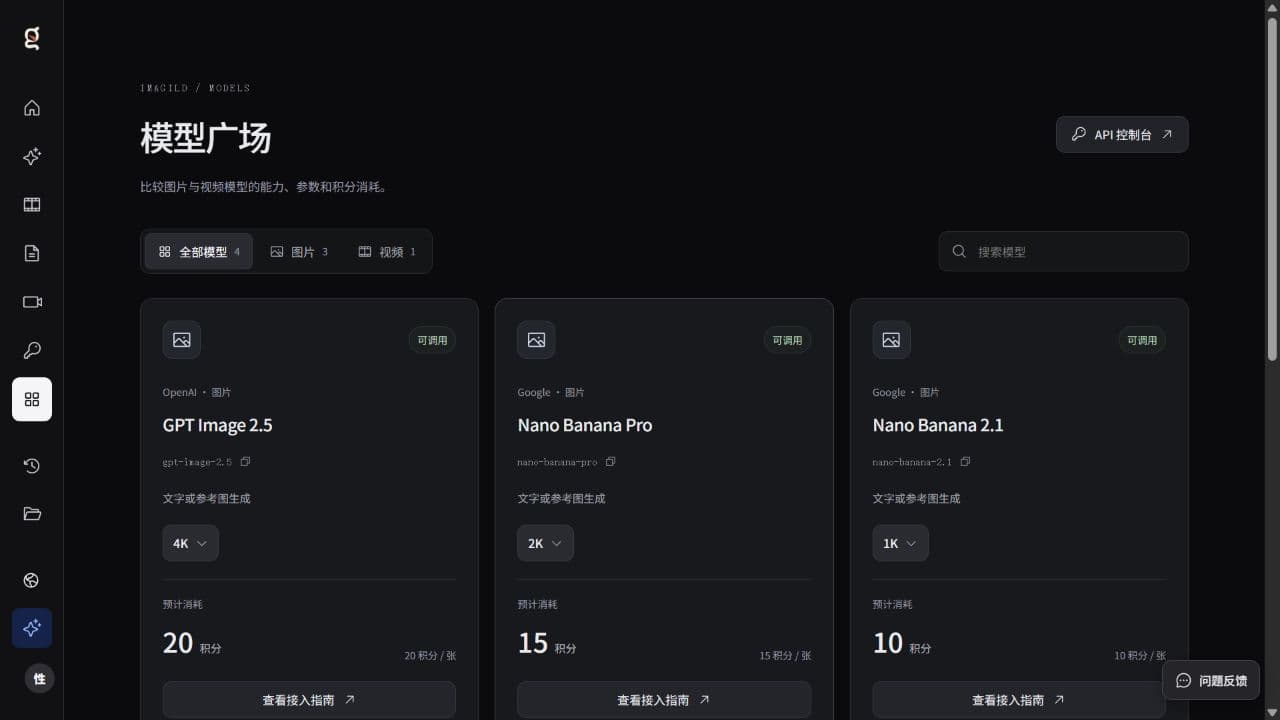
Separate local contract tests from explicitly budgeted real-model checks. A mock can validate your client without calling Imagild, while a live generation consumes account points and produces media that must be reviewed. Calling a test environment “staging” does not make its real API requests free or isolate its wallet automatically.
Key Takeaways
- Label evidence as mocked, authenticated read-only or paid model validation.
- Use an explicit point ceiling and acceptance brief for any live generation.
- Separate keys under one account still share that account's points and request budgets.
Choose the layer that answers the question
A request-shape bug belongs in a local fixture test. A key or membership problem can often be diagnosed through an authorized read. Whether a model renders correct text or a clip plays cleanly requires actual output review.
The Imagild API guide describes active membership, existing account points and asynchronous tasks. It does not expose a special free-generation sandbox just because your application's environment name is “test.”
| Layer | Can establish | Cannot establish |
|---|---|---|
| Local fake transport | Client parsing and recovery decisions | Real model content |
| Bounded authenticated read | Current access and catalog response | Generation quality |
| Approved paid operation | That specific task and reviewed output | Universal uptime or quality |
Keep those labels in your release report so a passing mock never appears as a production generation result.
Define a small paid check before starting it
For example, one 1K image plus one four-second 768P video using that successful image task plans seventy generation points with enhancement disabled: ten for the image and sixty for the video.
This is a hypothetical allocation, not an executed test or permission to spend someone else's points. Verify current rates in the model hub, membership eligibility and the account balance before any real run. Retakes, a higher tier or enabled enhancement change the budget.
Record the exact brief, model choices, stop condition and person approving the spend. The points planning guide provides the account-budget context.
Make the transport choice explicit
Inject a fake transport by default in local tests and remove access to production credentials there. A live-check command or job should require an intentional configuration change and a saved test plan.
Do not rely on naming a key “development” as the spending control. Separate keys help operational management, but keys for one account do not create independent rate budgets or a free billing sandbox.
The Node test runner documentation describes local test and mocking facilities. Your test harness should reject unexpected network access rather than quietly falling through to a production HTTP client.
Inspect the result instead of stopping at acceptance
For a paid check, persist the task ID and observe its actual state. Download a successful output with authentication and verify media type, decoding, content and intended crop.
For video, play the complete file with sound and inspect its opening and ending. A thumbnail, HTTP 202 or a correct task envelope is insufficient media evidence. Do not report a mock's synthetic image bytes as a generated output.
If the task is failed or unknown, use the failed-job guide and stop automatic replacement work. Preserve the operation identity until the uncertainty is resolved.
Report the observed scope honestly
A useful report identifies the client version, test layer, approved budget, actual operation IDs, task outcomes and media-review decisions. Exclude secrets and private photographs from broad distribution.
Pass the relevant layer only when its own assertions succeed. One accepted clip can support a statement about that reviewed clip; it cannot justify a high-availability percentage, a seamless-continuity guarantee or a claim that every model integration has passed.
Related tasks
- Imagild Points, Resolution and Jobs: Plan a Creation Before You Spend
- What Should You Check Before Retrying a Failed Image or Video Job?
Sources and scope
- Imagild API console: Actual request and task envelopes, strict parameters, references, membership, points usage and authenticated result retrieval.
- Imagild model hub: Current advertised model capabilities, resolutions and generation point rates.
- Node.js test runner: Application-side testing and mocking facilities; not proof of live model performance.
Product instructions were checked against the current Imagild API contract and the public model catalog. Code, budgets and acceptance checks are illustrative; this article does not claim a new paid generation test, an uptime measurement, a search-volume study or a ranking of AI citations.
Prepared by Imagild Editorial, the company editorial team responsible for these guides. AI assisted research and drafting. This is documentation-based guidance with proposed examples, not a claim of hands-on testing or an independent product review. Report a correction.
Cover: Original Imagild product screenshot captured on 28 October 2026; model availability and prices may change. This image is not an API response or a performance benchmark.