Schedule daily media work in your own application, spread submissions over time and deduplicate each logical asset before calling Imagild. The API exposes individual asynchronous generations, not a hosted recurring-job or bulk-schedule endpoint. Your scheduler must handle duplicate clock events, missed runs, shared quotas and the spending limit you approved.
Key Takeaways
- Pick an explicit timezone and a durable logical-day identity.
- Create operation keys once and recover existing work after restarts.
- Catch-up runs need the same pacing and budget controls as normal runs.
Define what one daily job means
Specify the account, business date, asset identity and content revision. A scheduled event for “today's hero image” is incomplete if different machines disagree about the day or if a prompt changes after its operation was accepted.
Choose a timezone for the business date and store it with the plan. Store actual dispatch times in a consistent timestamp format as well. Do not derive production identity from whichever local clock happens to run a worker.
The Imagild API console documents requests and task recovery. Active membership and sufficient points must still be available when the scheduled work runs; a plan created earlier does not bypass those checks.
Build a durable daily manifest
This is an application-owned schedule record, not a payload accepted by an Imagild endpoint:
{
  "businessDate": "2026-10-29",
  "businessTimeZone": "UTC",
  "assetId": "catalog-lamp",
  "revision": 3,
  "operationKey": "catalog-20261029-lamp-v3",
  "notBefore": "2026-10-29T08:00:00Z",
  "payload": {
    "model": "gpt-image-2.5",
    "prompt": "A blue desk lamp on a pale studio plinth, soft side light",
    "resolution": "1K"
  },
  "taskId": null
}
The API receives the payload as JSON and the saved operation key as Idempotency-Key. It does not receive the schedule fields. Make the account/date/asset/revision combination unique in your own storage so a second clock event finds the existing record.
A revised creative brief requires a deliberate new revision and operation. Do not overwrite the submitted payload while keeping its previous key.
Spread dispatch instead of creating a midnight burst
Let the scheduler create due work without sending every request immediately. A separate dispatcher can pace the backlog within the account's current ten generation/upload writes per minute, leaving headroom for interactive work and retries.
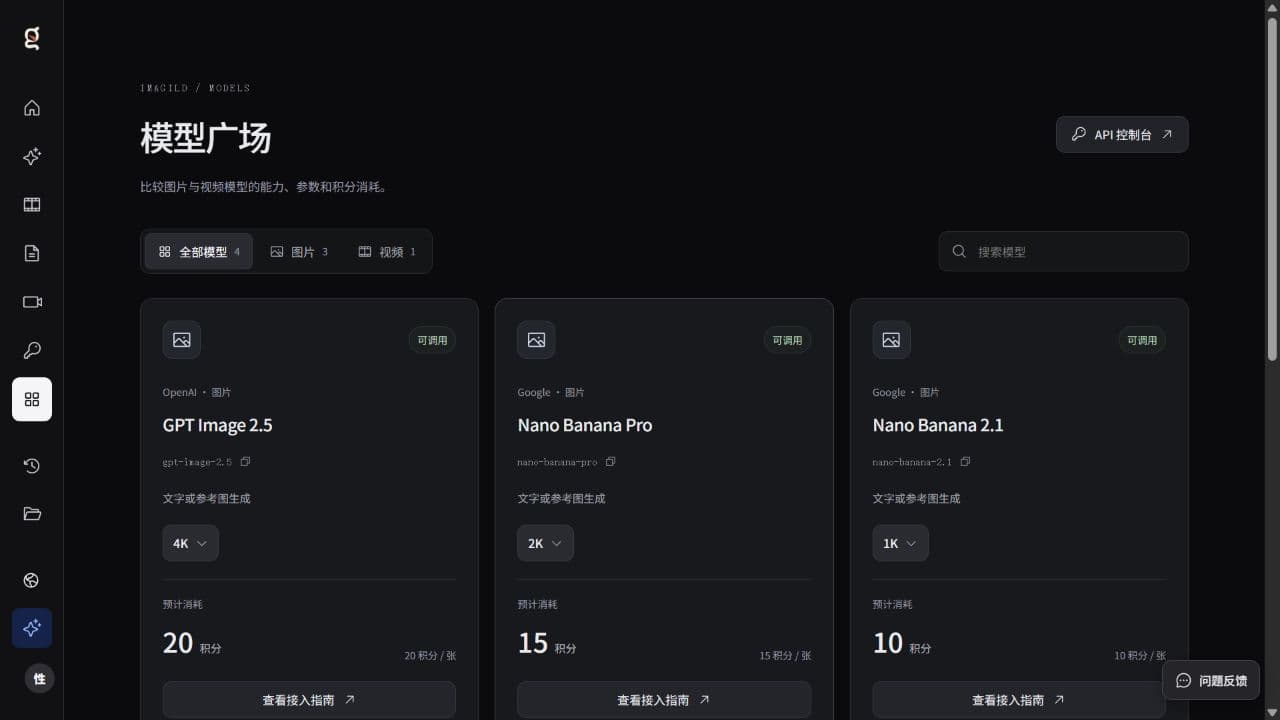
For twenty planned 1K images, the current generation allocation is 200 points. Reference uploads, if required, add write requests; separately generated reference images or retakes add generation costs. Check the model hub and the points planning guide before approving the daily budget.
Do not translate a dispatch allowance into a finish-time promise. Accepted tasks still require monitoring and result review, and downloads share the separate read budget.
Recover missed and repeated schedule events
Scheduled systems can produce duplicate events or miss an intended run. Kubernetes' CronJob documentation explicitly discusses approximate scheduling and the need for idempotent jobs. That is a useful general design lesson; using Imagild does not require Kubernetes.
On restart, inspect the manifest. If a task ID exists, continue its lifecycle. If acceptance was uncertain, retry the identical operation with its saved key and parameters. Never recreate all operation keys merely because a daily process starts again.
Set a catch-up policy: skip outdated promotional assets, or queue only a bounded number of missing days after approval. A month of missed jobs should not silently become a month's immediate spending.
Approve publication independently of the clock
A task that succeeds after its planned publication time is not automatically suitable for publication. Review the actual image or video and verify the date-sensitive content, text, crop and destination. Save the accepted output separately from the schedule's intention.
Use the failed-job next-action guide when a scheduled item fails or has an unknown outcome. Do not replace uncertain work automatically.
Test a duplicate event, a restart after acceptance, a missed-day catch-up and a membership-expiry response using local fixtures. Pass the workflow when each approved logical asset has a recoverable operation history, traffic remains paced and stale or failed items cannot publish simply because their scheduled time has arrived.
Related tasks
- Imagild Points, Resolution and Jobs: Plan a Creation Before You Spend
- What Should You Check Before Retrying a Failed Image or Video Job?
Sources and scope
- Imagild API console: Current request limits, retry handling, authentication and asynchronous task lifecycle.
- Imagild model hub: Current model options and media-generation point costs, separate from request-rate budgets.
- Kubernetes CronJob documentation: Approximate scheduled execution and idempotent-job design as a general lesson; Kubernetes is not required by Imagild.
Product instructions were checked against the current Imagild API contract and the public model catalog. Code, budgets and acceptance checks are illustrative; this article does not claim a new paid generation test, an uptime measurement, a search-volume study or a ranking of AI citations.
Prepared by Imagild Editorial, the company editorial team responsible for these guides. AI assisted research and drafting. This is documentation-based guidance with proposed examples, not a claim of hands-on testing or an independent product review. Report a correction.
Cover: Original Imagild product screenshot captured on 28 October 2026; model availability and prices may change. This image is not an API response or a performance benchmark.