An image variation needs a new Imagild idempotency key when the user intentionally approves another generation. That includes a changed prompt, model, resolution, or reference, but it can also include a second candidate with identical parameters. A retry fulfills the earlier approval; a variation authorizes new work.
Key Takeaways
- Keep the existing key when recovering the same submitted operation.
- Create a new operation for an intentional additional candidate, even if its prompt is unchanged.
- Check unresolved earlier work before presenting a variation as a repair or replacement.
Ask what the user is trying to obtain
The question is not only whether the JSON changed. Imagine a user who likes a composition but wants another candidate from the same brief. Sending the original key again retrieves or recovers the existing operation; it does not mean “make a second version.”
Conversely, a user who presses “Check my request” after a page reload wants the result they already approved. Creating a new key for that action can cause an unnecessary generation.
Stripe's idempotency documentation illustrates stable retry identities. Imagild's key length, task response, and retention behavior must be taken from its own contract rather than inferred from Stripe.
Use an intent-first decision table
| User action | Key decision | Application explanation |
|---|---|---|
| Resume a task after refreshing | Keep original identity | Checking already approved work |
| Recover a lost acceptance response | Keep key and original parsed request | Recovering the existing operation |
| Request another candidate with the same brief | New approved operation and key | Additional generation |
| Change 1K to 4K | New approved operation and key | Different tier and quote |
| Select another image model | New approved operation and key | Different model candidate |
| Replace the reference source | New approved operation and key | Different submitted source |
| Encounter unknown upstream outcome | Reconcile original operation first | Outcome is not yet established |
Do not use an automatic “fresh key on error” rule. The error might describe an access problem, conflict, or uncertainty rather than a need for a new creative attempt.
Separate variation controls from recovery controls
Give the result card two distinct paths. “Check task” should read the saved task ID. “Generate another candidate” should open a new draft that shows model, resolution, prompt, reference, and cost before approval.
A changed draft must not rewrite the original operation snapshot. Preserve a relationship such as “candidate B was requested after reviewing candidate A” in your application data. That relationship is useful for editorial review, but it is not an extra field to send in the strict image JSON body.
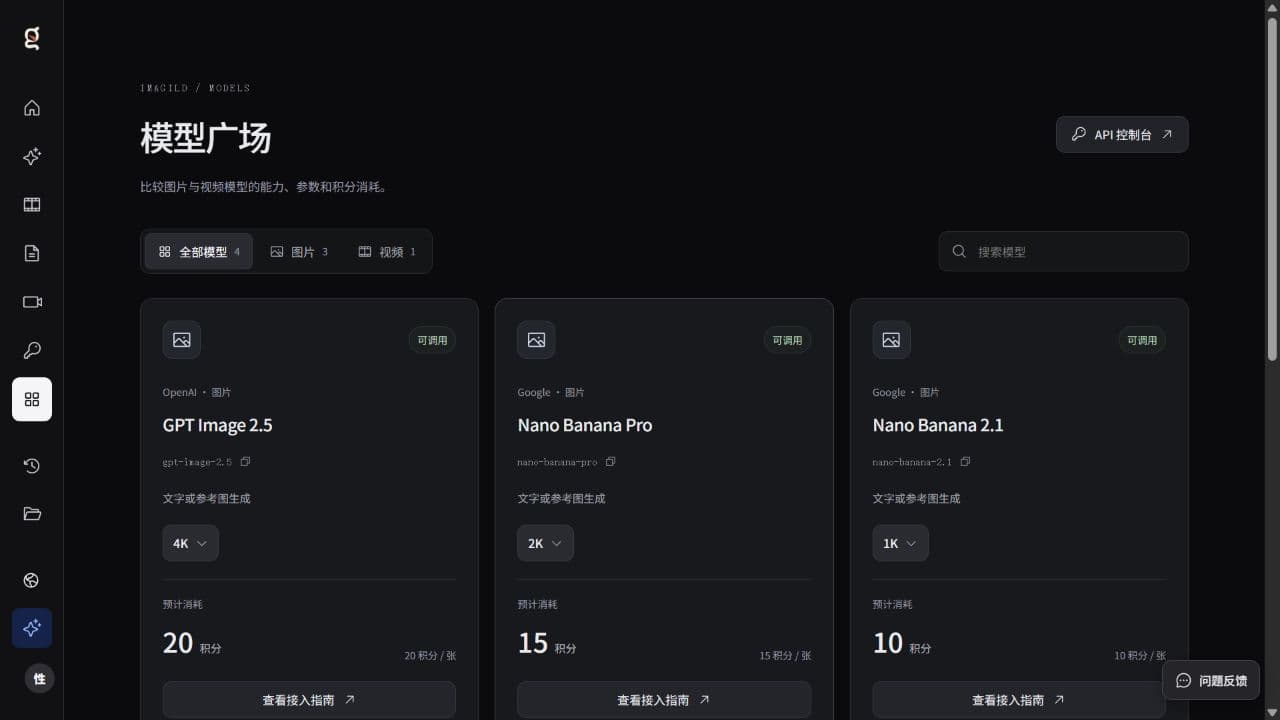
Imagild exposes gpt-image-2.5, nano-banana-pro, and nano-banana-2.1 as its current canonical image IDs. The API console describes the request fields. There is no need to invent a variation endpoint, n field, or seed control.
Quote the additional candidate honestly
All three public image choices currently use 10 points at 1K, 15 at 2K, and 20 at 4K. Check the model market before submission.
For example, one approved 1K candidate followed by one new 4K candidate allocates 30 generation points in total. The 4K request is not a ten-point upgrade payment or a guaranteed enlargement of the first result. It is a separate generation that needs its own acceptance review.
Active membership is required independently of the points balance. If you reuse a completed owned image as a reference, the new image request still needs meaningful instructions of at least 20 characters. Review preservation of important details rather than assuming a variation keeps everything unchanged.
Validate the distinction in your interface
With fixture tasks, test three user stories: refresh an accepted task, request a second candidate without editing, and change the resolution before approving a second candidate. The first should keep the saved identity; the other two should create explicit new operations.
Then simulate an unknown task outcome. The interface should preserve the unresolved record and offer reconciliation, not advertise a new generation as a free retry.
Use points and job planning for budget communication and the failed-job guide for recovery decisions. Stable task reuse is a useful reliability mechanism, but it is neither deterministic image reproduction nor global exactly-once execution.
Related tasks
- Imagild Points, Resolution and Jobs: Plan a Creation Before You Spend
- What Should You Check Before Retrying a Failed Image or Video Job?
Sources and scope
- Imagild API console: Strict image request contract, canonical IDs, reference instructions, reuse and membership.
- Imagild model market: Current per-operation image points.
- Stripe idempotent requests: Retry identifiers represent one logical operation; Stripe-specific storage and replay rules are not transferred.
Product instructions were checked against the current Imagild API contract and the public model catalog. Code, budgets and acceptance checks are illustrative; this article does not claim a new paid generation test, an uptime measurement, a search-volume study or a ranking of AI citations.
Prepared by Imagild Editorial, the company editorial team responsible for these guides. AI assisted research and drafting. This is documentation-based guidance with proposed examples, not a claim of hands-on testing or an independent product review. Report a correction.
Cover: Original Imagild product screenshot captured on 28 October 2026; model availability and prices may change. This image is not an API response or a performance benchmark.