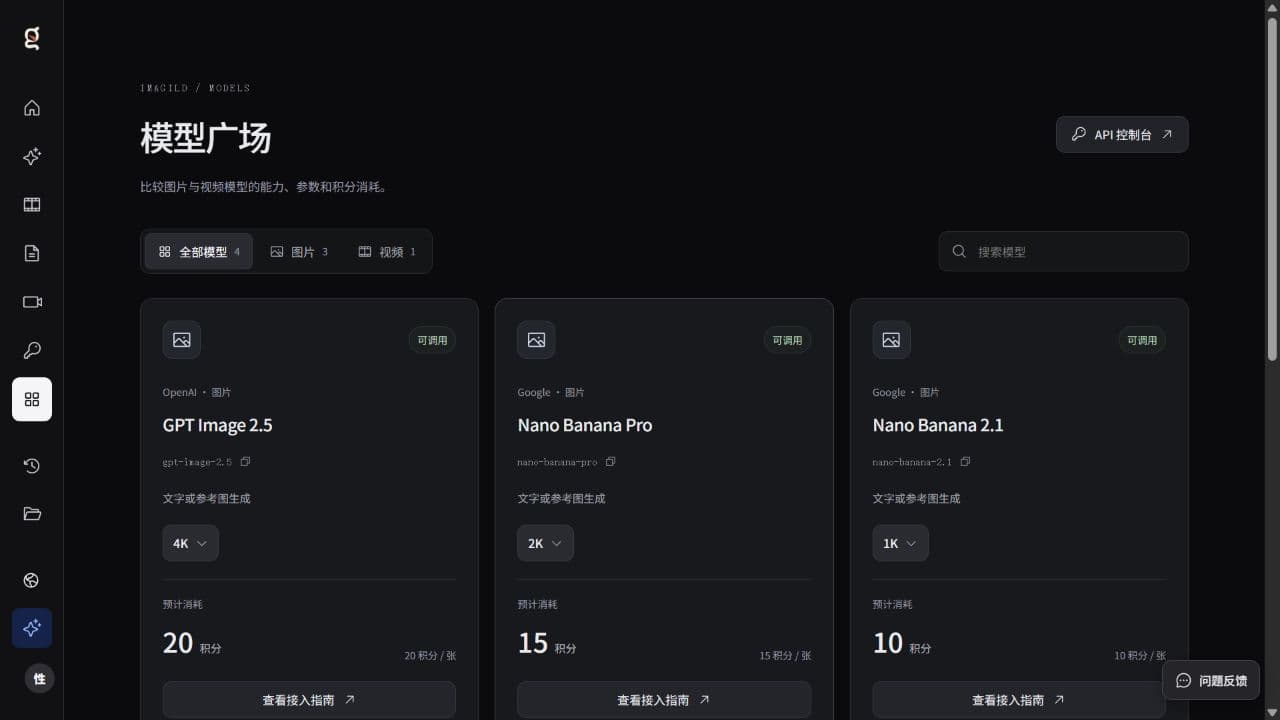
Choose an Imagild image resolution tier from the delivery requirement and the number of attempts you can fund. Current API pricing is 10 points for 1K, 15 for 2K, and 20 for 4K per image across the three public image choices. A higher tier is a paid generation choice, not proof that the composition will meet your brief.
Key Takeaways
- State an acceptance condition before choosing 1K, 2K, or 4K.
- Budget drafts, final generations, and retakes as separate operations.
- Inspect the downloaded file; a tier name is not an independently verified exact pixel measurement.
Start with where the image will be used
A thumbnail experiment and a full-screen product visual have different acceptance requirements. Write down the intended display area, allowable crop, important text, and whether the result will be used as a video reference. Then decide what a reviewer must inspect at the final delivery size.
For a small concept review, 1K can be a sensible first request when layout and subject are still undecided. For a larger asset, compare a 2K or 4K candidate against the actual destination. Do not promise that a higher setting fixes wrong wording, an unwanted pose, or an incorrect product detail.
Check the current Imagild model market before setting a budget. The authenticated catalog also reports available model resolution choices.
| Requested tier | Points per image | Five operations | Ten operations |
|---|---|---|---|
| 1K | 10 | 50 | 100 |
| 2K | 15 | 75 | 150 |
| 4K | 20 | 100 | 200 |
These are generation points, not a complete subscription quote. API use requires active membership. Buying a points pack alone does not unlock it, and a separate reference-image generation or another retake adds its own cost.
Make the draft-to-final budget explicit
Suppose you plan twelve 1K composition drafts and three separate 4K final candidates. The planned generation allocation is:
12 × 10 points = 120 points for drafts
 3 × 20 points =  60 points for final candidates
Total planned allocation = 180 points
The three final candidates are new generations. This arithmetic does not imply an upscale endpoint, deterministic reproduction of an approved draft, or automatic credit transfer from an earlier image. If you use an approved image as a reference for a new generation, review preservation of its important details again.
Keep a contingency separate from the committed plan. A 40-point retake allowance means two additional 4K operations, not unlimited retries. Network retries of the same accepted operation should retain the same idempotency key; a deliberate new candidate needs a new operation identity.
For the account-wide context, read points, resolutions, and jobs. Preserve each submitted task's quoted usage rather than recalculating an old job from a later price table.
Separate generation size from web delivery
After approving the source, a website can create appropriate display derivatives through its own media pipeline. Smaller delivery files, responsive sizes, and format optimization address transfer and rendering costs. They do not retroactively change the model request.
Cloudinary's image optimization documentation treats dimensions, quality, and format as delivery decisions. That distinction is useful even if you do not use Cloudinary. Its transformation fields are not supported Imagild generation parameters.
Imagild's image JSON exposes resolution, not arbitrary width, height, or aspect_ratio. Exact image dimensions and output encoding must be checked from the completed file. The resolution capability guide explains why model mode also matters when planning a media workflow.
Approve against a short delivery checklist
Before publishing, verify that the task succeeded, download its authenticated result, and inspect the decoded width and height. Review text, crop safety, product details, and intended use rights. If the image fails a content requirement, document that failure before choosing a retake.
The API console provides the submission and polling flow. Show the user their chosen tier and points before sending it. Clear prices and explicit acceptance checks make a budget controllable without claiming that every higher-priced output will be better.
Related tasks
- Imagild Points, Resolution and Jobs: Plan a Creation Before You Spend
- Why Can This Image Model Generate 4K but Not Edit My Reference at 4K?
Sources and scope
- Imagild model market: Current image tier choices and 1K/2K/4K point prices.
- Imagild API console: API eligibility and request/poll/download workflow.
- Cloudinary image optimization: Delivery dimensions, encoding quality and format optimization are separate from generating a source image.
Product instructions were checked against the current Imagild API contract and the public model catalog. Code, budgets and acceptance checks are illustrative; this article does not claim a new paid generation test, an uptime measurement, a search-volume study or a ranking of AI citations.
Prepared by Imagild Editorial, the company editorial team responsible for these guides. AI assisted research and drafting. This is documentation-based guidance with proposed examples, not a claim of hands-on testing or an independent product review. Report a correction.
Cover: Original Imagild product screenshot captured on 28 October 2026; model availability and prices may change. This image is not an API response or a performance benchmark.