Compare image APIs using the same creative task, verified output requirements and complete access costs rather than a headline price alone. Imagild offers explicit resolution-point pricing and one account wallet across website and API, but its routing names and published rates do not establish that it is the cheapest or highest-quality option for every workload.
Key Takeaways
- Include access eligibility, retakes and delivery work in the comparison.
- Inspect actual downloaded outputs at the intended size.
- Measure your own observed reliability without converting it into a provider SLA.
Write one acceptance brief for every candidate
Choose a task such as a product image with a readable label and a safe mobile crop. State which wording, product details and composition must be correct. An API that returns quickly but fails that brief has not delivered an accepted asset.
Keep input rights, reference material and review criteria consistent. If services expose different controls, document the difference rather than inventing an equivalent setting.
The Imagild API guide uses strict request fields and asynchronous task retrieval. A familiar model name does not make another provider's request schema or response format interchangeable.
Calculate the published point equivalent carefully
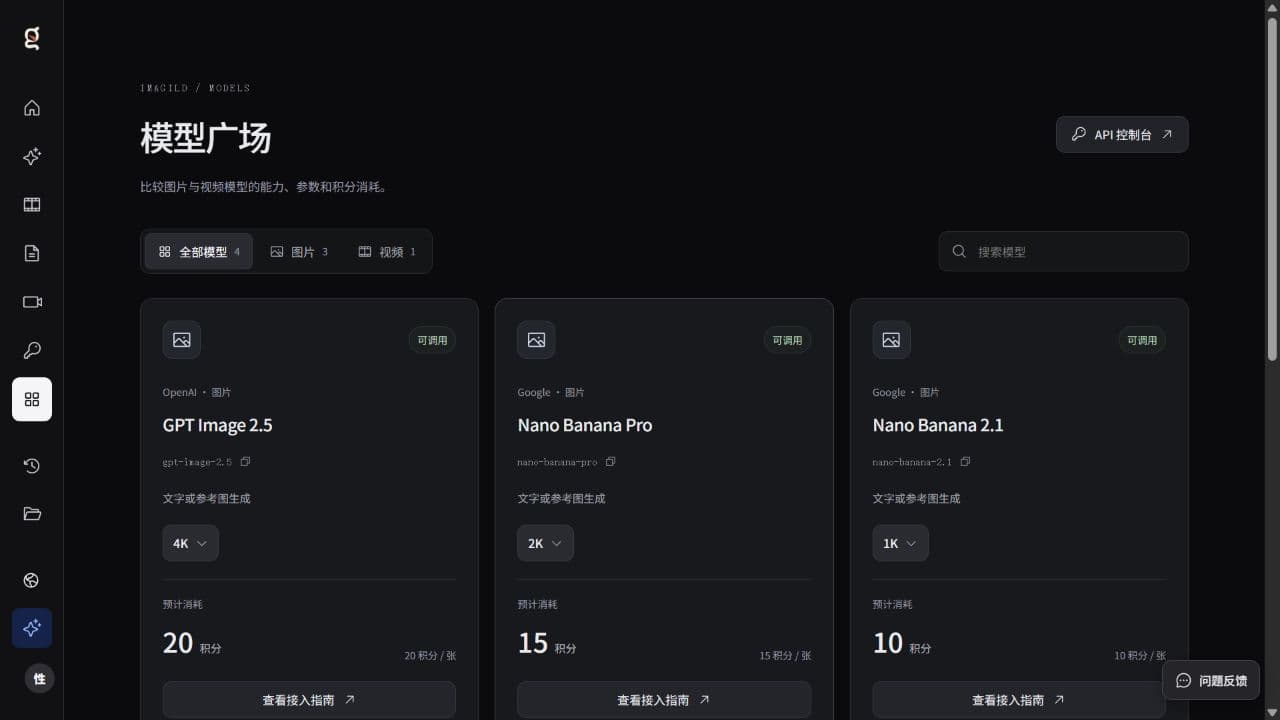
Current Imagild image requests use ten points at 1K, fifteen at 2K and twenty at 4K. Verify the model hub and US-dollar point plans before using those rates.
For the published Studio pack, the arithmetic for one ten-point request is:
$79.99 / 6,000 points × 10 points = about $0.1333
That is the purchased-point equivalent, not an unconditional all-in API price. Active membership is separately required; unused balances, applicable checkout terms, extra reference-image generations and retakes can affect the practical cost.
Do not call signup points free API access or assume a points purchase alone satisfies membership.
Fill a workload-specific comparison sheet
Leave competitor fields blank until verified from their own current documentation and your approved tests:
| Question | Evidence to collect |
|---|---|
| What is billed? | Per image, per operation or another documented unit |
| What access is required? | Membership, account conditions and payment terms |
| What output was delivered? | Decoded dimensions, format, crop and content review |
| How many attempts were accepted? | Task-linked review decisions and retake count |
| What limits apply? | Current request limits and supported parameters |
| What remains unresolved? | Pending tasks, unknown outcomes and download failures |
The sheet is a method, not a prefilled ranking. At equal request counts, two services can have different accepted-output counts. Record both rather than hiding rejected candidates.
Separate generation from delivery engineering
A requested tier is not an independently verified pixel measurement. Download the result, check its encoding and dimensions, then inspect the intended destination crop and text.
Cloudinary's optimization documentation separates delivery dimensions, quality and format. Those downstream steps can matter to a production budget even when they occur outside the generation API.
Use the resolution and job guide for Imagild budgeting context. Keep any website derivatives distinct from the original generated master.
Explain reliability and advantages with evidence
Track HTTP failures, final task outcomes, unknown results and media-review failures separately. Stripe's error-handling guide illustrates why failure categories lead to different recovery actions; its contract does not define Imagild's service guarantees.
The failed-job checks help diagnose Imagild outcomes before retaking a candidate. Useful documented advantages include an existing points wallet, visible tier pricing and reusing a successful image task as a video reference.
Pass your comparison when the inputs, access costs, observed outcomes and review criteria are disclosed. Prefer a supported workload-specific conclusion over an unsupported “cheapest,” “best” or guaranteed-availability claim.
Related tasks
- Imagild Points, Resolution and Jobs: Plan a Creation Before You Spend
- What Should You Check Before Retrying a Failed Image or Video Job?
Sources and scope
- Imagild API console: Actual request and task envelopes, strict parameters, references, membership, points usage and authenticated result retrieval.
- Imagild model hub: Current advertised model capabilities, resolutions and generation point rates.
- Imagild US-dollar point plans: Published Studio pack of $79.99 for 6,000 points; API membership eligibility is separately required.
- Cloudinary image optimization: Downstream dimensions, quality and format are delivery decisions separate from source generation.
- Stripe advanced error handling: General distinction between content, network and server errors; Stripe-specific payment and replay rules are not transferred.
Product instructions were checked against the current Imagild API contract and the public model catalog. Code, budgets and acceptance checks are illustrative; this article does not claim a new paid generation test, an uptime measurement, a search-volume study or a ranking of AI citations.
Prepared by Imagild Editorial, the company editorial team responsible for these guides. AI assisted research and drafting. This is documentation-based guidance with proposed examples, not a claim of hands-on testing or an independent product review. Report a correction.
Cover: Original Imagild product screenshot captured on 28 October 2026; model availability and prices may change. This image is not an API response or a performance benchmark.