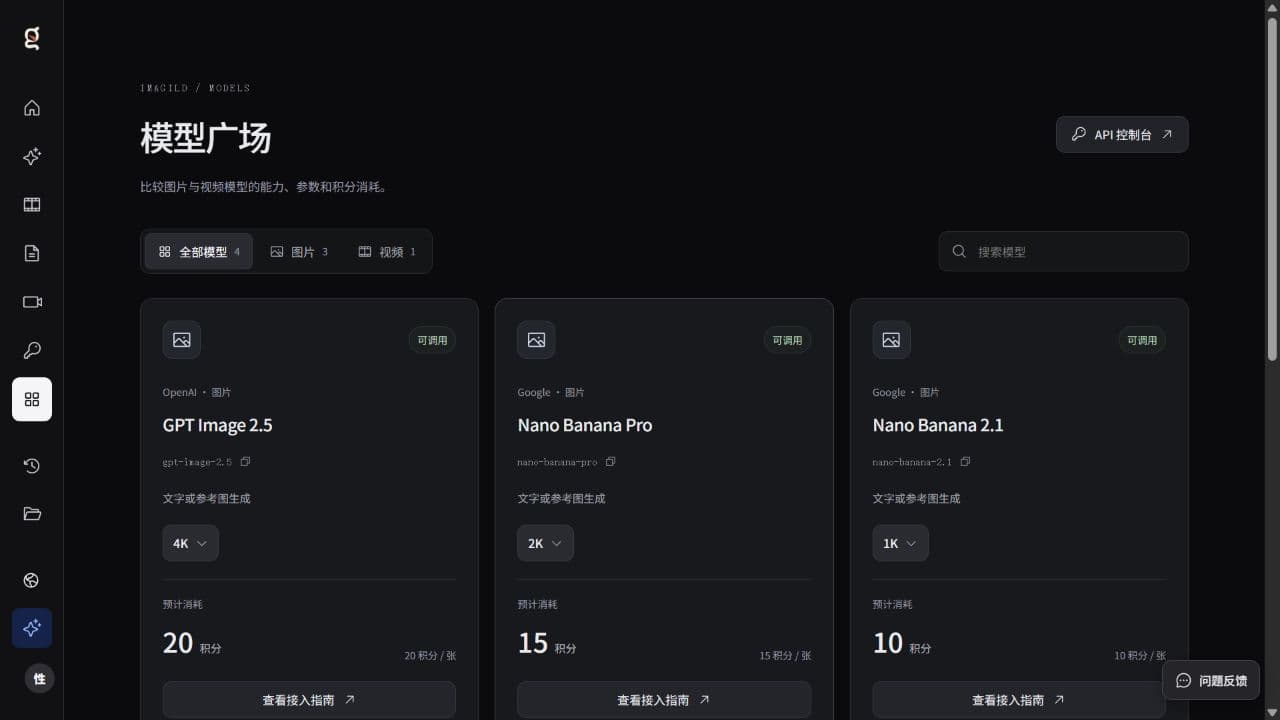
Calculate an Imagild image budget by multiplying the required points by the unit value of the points pack you actually buy. Each current public image model uses 10 points at 1K, 15 at 2K and 20 at 4K. Treat membership as a separate cost and eligibility requirement, rather than hiding it inside an advertised per-image figure.
Start with the current model hub and points plans. The figures below are arithmetic from the published USD packs checked on 28 October 2026, not a claim that Imagild is cheaper than every alternative.
Key Takeaways
- Use the same 10/15/20-point image schedule for the three public image model choices.
- Distinguish allocated points value from the cash amount paid to purchase a pack.
- Keep membership, checkout terms, unused points and additional generations visible.
Convert a pack into a unit value
The formula is straightforward:
USD value allocated to one generation
  = pack price in USD / pack points × generation points
For the current packs, the conversion is:
| Pack | Upfront USD | Points | 1K: 10 points | 2K: 15 points | 4K: 20 points |
|---|---|---|---|---|---|
| Essential | $9.99 | 500 | $0.1998 | $0.2997 | $0.3996 |
| Creator | $29.99 | 2,000 | $0.1500 | $0.2249 | $0.2999 |
| Studio | $79.99 | 6,000 | $0.1333 | $0.2000 | $0.2666 |
Displayed unit values are rounded to four decimal places. Calculate with the full fraction before rounding a total. For example, Creator's exact 1K allocation is $0.14995, not a newly published fifteen-cent checkout item.
These are values of purchased points, excluding separate membership eligibility, applicable taxes and checkout terms. Buying a Studio pack means an upfront $79.99 purchase; it does not mean the checkout charges only $0.1333 whenever you generate an image.
Estimate a real mixed-resolution batch
Suppose a product team plans 30 concept images at 1K and ten final image generations at 4K. The planned generation budget is:
30 × 10 + 10 × 20 = 500 points
If every task succeeds, this exactly matches the Essential pack's 500 points. Allocating 500 existing Studio-pack points instead gives approximately $6.6658 of purchased-points value, but obtaining that pack originally required its full purchase price.
Keep creative retakes outside this initial total. A completed but unsuitable image still represents completed generation. A further prompt revision or changed resolution is another operation, rather than a free adjustment to the earlier output.
The points and resolution guide provides broader account context for those decisions.
Avoid misleading comparisons
A useful quote identifies model, resolution, quantity and acceptance requirements. The gateway IDs gpt-image-2.5, nano-banana-pro and nano-banana-2.1 share the current point schedule; that does not establish identical output quality or official SDK compatibility.
Other services also distinguish units and settings when explaining price. Runware's pricing reference illustrates that general principle; its USD billing and payment features do not define Imagild's account rules.
Do not compare only the lowest displayed number while omitting membership, retakes or unused balances. If you allocate a membership payment across a campaign, state the method, such as the portion assigned to that campaign's successful outputs. Use your actual membership terms; no membership price is assumed here.
Verify the estimate against task usage
Imagild accepts generation asynchronously. Persist the returned task ID, then inspect data.usage.points and data.usage.state from its authenticated status record. Reserved points and consumed points describe different stages.
Build a local test with ten planned images and sum their point quotes before any paid request. After an approved controlled run, compare each saved task's usage with its planned resolution, rather than relying only on a change in the shared wallet.
Use the API console for the integration contract and the existing points explanation for account terminology. A transparent estimate lets the customer decide what to buy without implying a minimum-price ranking or guaranteed number of acceptable images.
Related tasks
- Imagild Points, Resolution and Jobs: Plan a Creation Before You Spend
- How do Imagild points work for photos and video?
Sources and scope
- Imagild API console: Current active-member access, generation contract and per-task usage fields, independently cross-checked in lib/relay and claims.json dated 2026-10-28.
- Imagild model hub: Current image 10/15/20-point tiers, H3 duration/resolution rates and five-point enhancement option; not a quality or comparative availability benchmark.
- Imagild points plans: Current public USD points packs, checked against lib/billing/points-catalog.json. Allocated point value excludes separate membership eligibility and applicable checkout terms.
- Runware Pricing: General distinction between configuration-based generation pricing, per-request cost and account payment management. Runware-specific fields, features and policies are not attributed to Imagild.
Product instructions were checked against the current Imagild API contract and the public model catalog. Code, budgets and acceptance checks are illustrative; this article does not claim a new paid generation test, an uptime measurement, a search-volume study or a ranking of AI citations.
Prepared by Imagild Editorial, the company editorial team responsible for these guides. AI assisted research and drafting. This is documentation-based guidance with proposed examples, not a claim of hands-on testing or an independent product review. Report a correction.
Cover: Original Imagild product screenshot captured on 28 October 2026; model availability and prices may change. This image is not an API response or a performance benchmark.