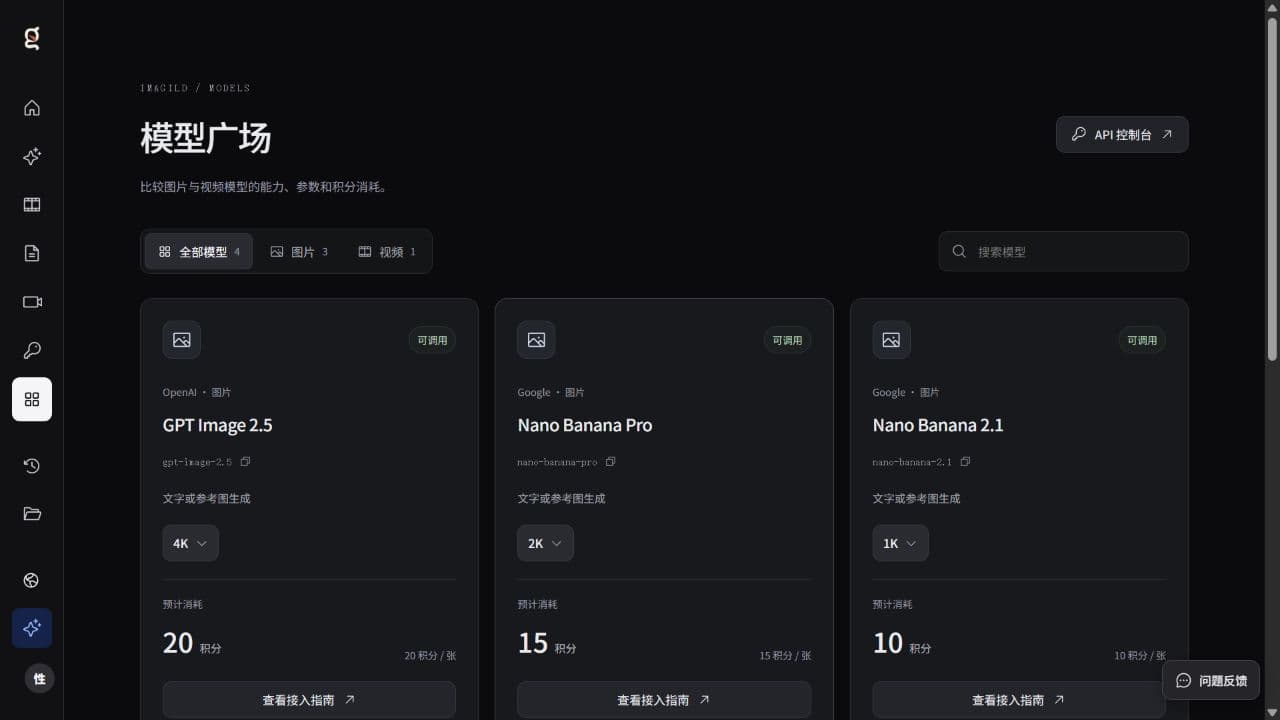
Read the saved quote attached to an existing Imagild task rather than repricing its completed work from today's model dropdown. A new operation uses the pricing applicable to that new work. An existing task's usage record is the place to verify its own points and reservation outcome.
The model hub describes current choices, while the API console describes how to read a saved task. Keeping those roles separate prevents a future catalog update from rewriting your customer's history.
Key Takeaways
- Persist each task's returned
usage.pointsand usage state with its operation identity. - Use the current catalog to quote future operations, not to overwrite historical task rows.
- Changing model, resolution or prompt creates new work rather than repricing the original request.
Separate three records in your application
| Record | What it describes | What should update it |
|---|---|---|
| Current catalog | Available settings and current prices | A fresh catalog read |
| Unsubmitted draft estimate | The next operation the user is considering | Deliberate changes before confirmation |
| Existing task usage | That task's saved quote and billing state | A read of the same task record |
For image tasks, Imagild stores the quoted points with the submitted request. Video generation also records its point cost with the generation attempt. Do not invent a public pricing_version response field: the task response gives you usage.points and usage.state.
Before a reservation or generation has actually been established, an initializing task can show not_reserved. Treat that observation as initialization evidence, not as a completed charge or an unlimited promise about future unsubmitted work.
Preserve the task's own quote in a ledger
Suppose a 4K image task reports 20 points and later succeeds with consumed usage. Save that 20-point record under its task ID.
If the catalog later changes, the historical row should still come from the task, not from multiplying its old resolution label by a new global rate. This example does not announce an upcoming price change; it describes how your integration should behave if pricing changes.
A suitable application record might retain:
{
  "operation": "cover-final-20261028-0017",
  "taskId": "11111111-1111-4111-8111-111111111111",
  "requestedResolution": "4K",
  "observedUsage": { "points": 20, "state": "consumed" },
  "observedAt": "2026-10-28T12:00:00Z"
}
These surrounding field names belong to your application. The UUID and observation time are illustrative, not a real task to query.
Keep retry identity stable through a catalog refresh
A network retry of the same operation retains the original Idempotency-Key and unchanged parsed parameters. A newer catalog does not justify manufacturing a replacement identity for uncertain accepted work.
Stripe's idempotency documentation explains the general value of stable retry identity. Its replay behavior and retention periods are Stripe-specific; Imagild reuses the matching task and rejects changed parameters under the same key.
If the customer explicitly chooses a different model or resolution, create a new operation and ask for approval of its current quote. Preserve the earlier task instead of renaming it or replacing its recorded price.
Distinguish point history from cash allocation
A task quote is expressed in points. The USD value you allocate to those points may depend on which pack you purchased and your own accounting method. A later pack purchase should not rewrite the original task's point usage.
Likewise, active membership remains a separate access requirement. Buying points at another pack's unit value does not change which task consumed them or grant an API entitlement by itself.
The points and image-cost guide and resolution planning guide provide context for displaying those distinctions.
Check the historical-view behavior
Create a local fixture for an old 20-point task and a separate catalog fixture with a hypothetical changed price. Verify that the draft estimator updates while the existing task still displays its observed 20-point usage.
Then change the fixture from reserved to consumed and confirm the task row changes state without appending a second debit. If the observed quote appears inconsistent, retain the task ID and source evidence for review rather than calculating a corrective charge on the client.
Related tasks
- How do Imagild points work for photos and video?
- Imagild Points, Resolution and Jobs: Plan a Creation Before You Spend
Sources and scope
- Imagild API console: Current active-member access, generation contract and per-task usage fields, independently cross-checked in lib/relay and claims.json dated 2026-10-28.
- Imagild model hub: Current image 10/15/20-point tiers, H3 duration/resolution rates and five-point enhancement option; not a quality or comparative availability benchmark.
- Stripe Idempotent Requests: Stable logical request identity as a general retry-safety design principle. Stripe-specific replay, key lengths, expiration and payment guarantees are not applied to Imagild.
Product instructions were checked against the current Imagild API contract and the public model catalog. Code, budgets and acceptance checks are illustrative; this article does not claim a new paid generation test, an uptime measurement, a search-volume study or a ranking of AI citations.
Prepared by Imagild Editorial, the company editorial team responsible for these guides. AI assisted research and drafting. This is documentation-based guidance with proposed examples, not a claim of hands-on testing or an independent product review. Report a correction.
Cover: Original Imagild product screenshot captured on 28 October 2026; model availability and prices may change. This image is not an API response or a performance benchmark.