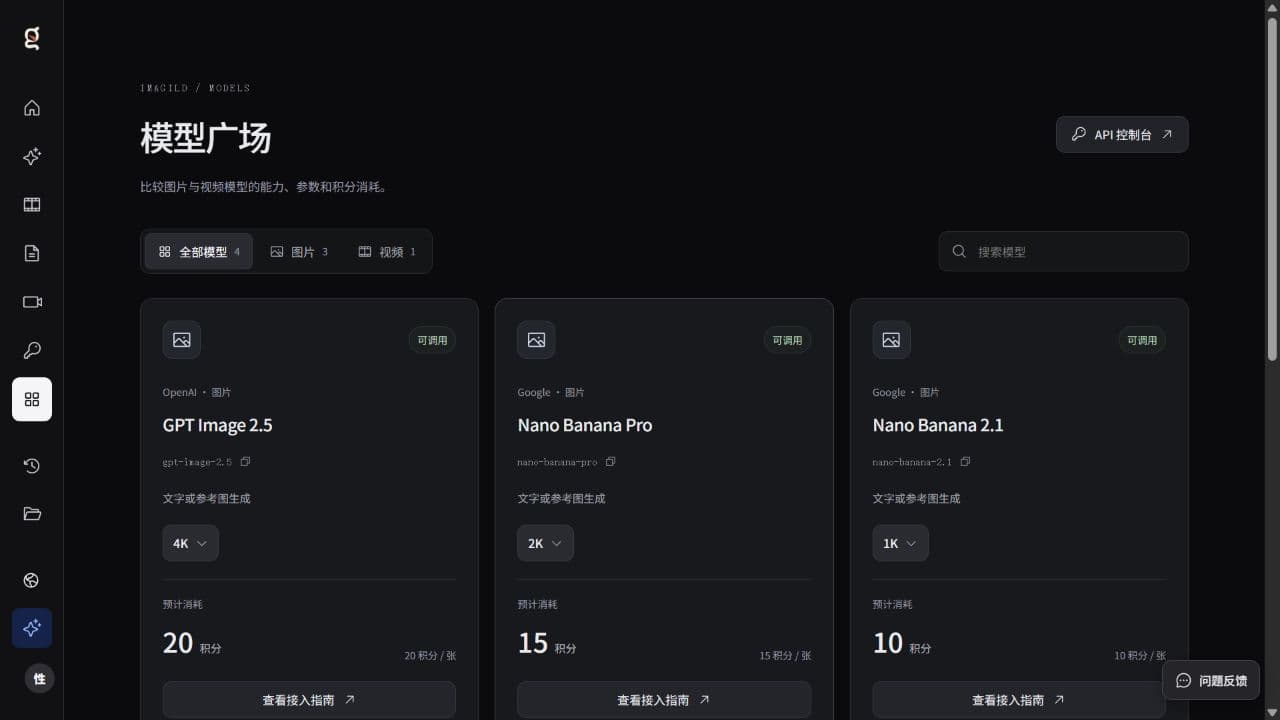
Switching the image model should create a new draft for a new operation, while existing jobs keep their original task IDs, inputs, and results. In Imagild, changing an accepted request's model while reusing its idempotency key produces a parameter conflict. A model selector should never silently mutate a submitted task.
Key Takeaways
- Keep submitted operation records immutable; a dropdown controls the next draft.
- A deliberate model change requires a new operation key and a fresh point quote.
- Continue polling earlier tasks by their stored IDs even after the user selects another model.
Separate the draft from submitted work
A common UI mistake is to use one global selectedModel value for both the next request and every task card. The user starts a GPT Image2.5 job, chooses Nano Banana Pro, and suddenly the pending card is labeled with the new model. The result history is now misleading even if the backend behaves correctly.
Use two kinds of state. Draft state contains editable prompt, model, resolution, and reference selection. Operation state contains the exact submitted payload, stable idempotency key, returned task ID, and observed status. The current dropdown must not overwrite the second record.
The available image IDs are gpt-image-2.5, nano-banana-pro, and nano-banana-2.1. Refresh authenticated GET /models when necessary and check the model market. Do not invent a fallback alias because a model is missing.
Construct a replacement only after confirmation
This server-side JavaScript example creates a new operation plan from an existing submitted record. It does not submit anything. Call it after the user confirms a new candidate, not on every dropdown event.
import { randomUUID } from "node:crypto";

function planDifferentModel(existing, nextModel, liveImageIds) {
  if (!liveImageIds.includes(nextModel)) {
    throw new Error("Choose a currently available image model");
  }
  if (nextModel === existing.payload.model) {
    throw new Error("The model has not changed");
  }
  return {
    payload: { ...existing.payload, model: nextModel },
    idempotencyKey: randomUUID(),
    taskId: null,
    comparisonSourceTaskId: existing.taskId
  };
}
Persist the returned plan before submission. Keep comparisonSourceTaskId in your own application record; it is not a supported generation JSON field. Send only payload to the API, and place its operation key in the Idempotency-Key header.
Current image tier costs are 10 points for 1K, 15 for 2K, and 20 for 4K. A second 2K candidate adds a separate 15-point generation allocation even if the first candidate is still pending. API eligibility requires active membership; a points pack alone does not grant access.
Distinguish comparison from recovery
A model comparison is deliberate new work. A network retry is an attempt to discover or complete the same logical operation. For an uncertain submission, keep the original model, payload, and key. Do not switch models to “unstick” a request whose outcome you have not established.
Stripe's idempotency guide explains the general value of matching retry identity to one operation. Imagild uses its own task-reuse and conflict rules, not Stripe's replay duration or payment semantics.
When an old task has an ambiguous outcome, preserve its record and reconcile it. Creating a new key and selecting another model can create additional paid work; it does not cancel the previous job.
Keep polling independent of the settings panel
A polling worker should read task IDs from operation records. It should not reconstruct a status request from the latest draft or replace every active task when the user changes settings.
Read data.status, task errors, and usage.state for each ID. Keep successful results independently downloadable. For a confirmed failure, use the failed-job next-action guide before offering a replacement.
Provider contracts also differ beyond model naming. Runware's model schema guide demonstrates model-specific validation. Imagild currently exposes a deliberately small strict image schema, without seed, n, size, or image aspect_ratio; do not reveal unsupported controls during a switch.
Compare labeled results against one brief
Keep the same acceptance brief for both candidates and record any deliberate prompt or resolution changes. Compare downloaded outputs at the intended display size, checking text, subject, and reference preservation. Catalog names do not establish a quality ranking or guarantee an identical picture.
The API console supplies the exact submission contract. Use points and job planning for budget context. Separate editable drafts from durable jobs so model exploration remains understandable and every completed result retains its true origin.
Related tasks
- What Should You Check Before Retrying a Failed Image or Video Job?
- Imagild Points, Resolution and Jobs: Plan a Creation Before You Spend
Sources and scope
- Imagild API console: Task IDs, strict request shape, idempotent reuse and changed-parameter conflicts.
- Imagild model market: Current model IDs and per-resolution points.
- Stripe idempotent requests: Stable operation identity for network retries; Stripe-specific replay semantics are not transferred.
- Runware Model Schemas: Parameter validation belongs to the receiving model contract rather than model-name similarity.
Product instructions were checked against the current Imagild API contract and the public model catalog. Code, budgets and acceptance checks are illustrative; this article does not claim a new paid generation test, an uptime measurement, a search-volume study or a ranking of AI citations.
Prepared by Imagild Editorial, the company editorial team responsible for these guides. AI assisted research and drafting. This is documentation-based guidance with proposed examples, not a claim of hands-on testing or an independent product review. Report a correction.
Cover: Original Imagild product screenshot captured on 28 October 2026; model availability and prices may change. This image is not an API response or a performance benchmark.