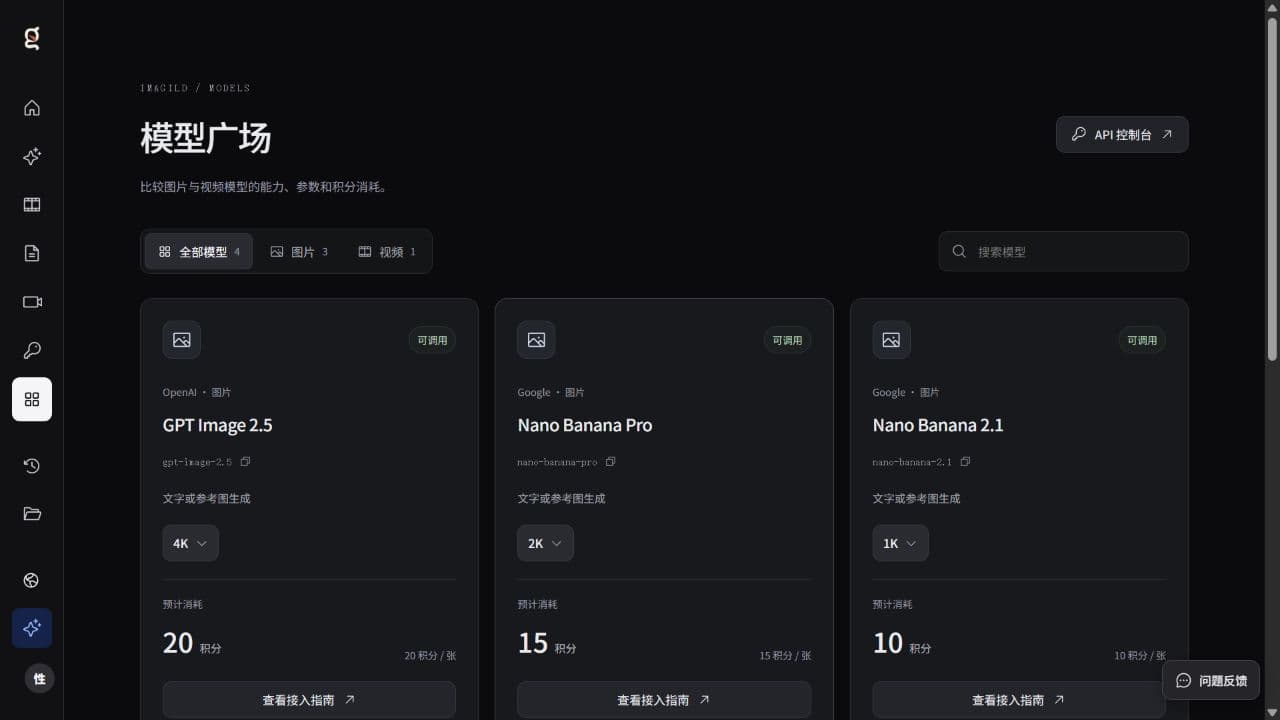
Reconcile an Imagild batch by joining your planned operation manifest to one latest usage record per task ID. Sum consumed points as completed generation usage, retain reserved points as unresolved commitments, and record released reservations separately. Do not add every polling response as another spending row.
The API console exposes per-task status and usage, rather than a public relay endpoint that exports the entire account ledger. Your application therefore needs to preserve its own operation-to-task mapping.
Key Takeaways
- Reconcile logical operations and unique task IDs, not HTTP request counts.
- Keep consumed, released and unresolved totals separate.
- A batch report is not a complete wallet statement when the account also has other activity.
Export two small application datasets
The first dataset describes intent: operation ID, customer or campaign, selected model, parameters, approved point estimate and eventual task ID. The second describes your latest authenticated observation: task ID, remote status, usage.points, usage.state and observation time.
Use a left join from intent to observation so missing task receipts remain visible. An inner join would hide the exact uncertain operations that need investigation.
A simple illustrative CSV after joining might look like this:
operation,task_label,quoted_points,status,usage_state
catalog-a,task-A,10,succeeded,consumed
catalog-b,task-B,15,failed,released
catalog-c,task-C,20,queued,reserved
motion-a,task-D,60,succeeded,consumed
motion-b,task-E,60,unknown,reserved
The task labels are human-readable examples, not UUIDs to query. This CSV is your reporting format, not a payload accepted by a generation endpoint.
Compute totals that preserve uncertainty
For the five illustrative records:
| Reporting bucket | Points | Meaning |
|---|---|---|
| Consumed | 70 | Successful generation usage from tasks A and D |
| Released | 15 | Failed task B's released reservation |
| Still reserved | 80 | Queued task C and unknown task E |
| Original quoted total | 165 | Sum of the five task amounts |
The 165-point quote reconciles as 70 + 15 + 80. It is not accurate to describe all 165 as completed spending, or to describe all 95 unconsumed points as already available.
If a row reports not_reserved, keep it in a separate initialization bucket. If an operation has no task ID because its response was lost, report it as missing receipt and recover the original identity before making financial conclusions.
Deduplicate before summing
Keep only the latest usable observation for each task, while retaining historical observations for audit if your retention policy allows it. Ten status reads for a 20-point task still represent one task.
Repeated queue deliveries should reuse the same operation record. A deliberate creative revision is a different operation and must remain visible as such. Do not merge two successful retakes merely because their prompts are similar.
Stripe's idempotency documentation explains why stable logical identity helps retries. Its exact response replay and retention behavior is not an Imagild feature; the applicable Imagild rule is same key plus identical parsed parameters reusing the task.
Explain differences from the shared wallet
A campaign's task table will not necessarily explain the entire account balance. The account may have website generations, unrelated campaigns, point purchases or older tasks. Membership payments also sit outside this points-only generation subtotal.
If you assign a USD value to consumed points, document which pack-unit value you used and keep the exact points visible. The points and image-cost guide provides account terminology; the resolution budget guide helps verify task estimates.
Validate the report with controlled fixtures
Load the five CSV examples into your reporting code and confirm 70 consumed, 15 released and 80 reserved. Duplicate one observation and ensure totals do not change. Remove a task receipt and ensure the row appears in an exception list rather than disappearing.
For an unknown video, preserve the task for reconciliation and exclude it from confirmed-success totals. For a released task, do not create a second local release transaction when refreshing the report. Finish the batch review by listing unresolved operations, not by forcing the numbers into a fictitious all-completed total.
Related tasks
- How do Imagild points work for photos and video?
- Imagild Points, Resolution and Jobs: Plan a Creation Before You Spend
Sources and scope
- Imagild API console: Current active-member access, generation contract and per-task usage fields, independently cross-checked in lib/relay and claims.json dated 2026-10-28.
- Imagild model hub: Current image 10/15/20-point tiers, H3 duration/resolution rates and five-point enhancement option; not a quality or comparative availability benchmark.
- Stripe Idempotent Requests: Stable logical request identity as a general retry-safety design principle. Stripe-specific replay, key lengths, expiration and payment guarantees are not applied to Imagild.
Product instructions were checked against the current Imagild API contract and the public model catalog. Code, budgets and acceptance checks are illustrative; this article does not claim a new paid generation test, an uptime measurement, a search-volume study or a ranking of AI citations.
Prepared by Imagild Editorial, the company editorial team responsible for these guides. AI assisted research and drafting. This is documentation-based guidance with proposed examples, not a claim of hands-on testing or an independent product review. Report a correction.
Cover: Original Imagild product screenshot captured on 28 October 2026; model availability and prices may change. This image is not an API response or a performance benchmark.