Measure your application's media workflow in separate layers: HTTP transport, accepted operations, task outcomes, downloaded media and reviewed deliverables. An API response can succeed while its task fails, and a task can succeed while its image fails your brief. One combined “success rate” hides these differences and cannot establish a provider SLA.
Key Takeaways
- Count logical operations separately from repeated HTTP requests.
- Keep pending and unknown outcomes visible in the denominator.
- Label all example numbers and report only the observation period you actually measured.
Define the question each metric answers
Transport metrics answer whether a request received an expected response. Task metrics answer what happened to accepted work. Delivery metrics answer whether the file decoded, played and met your application requirements.
The Imagild API guide exposes task status, errors and usage.state; it does not provide your application's complete monitoring dashboard. A successful HTTP 200 status read can still report a failed generation.
OpenTelemetry's observability primer describes instrumentation through signals such as metrics, logs and traces. You must implement that instrumentation in your own client or service; this is not a claim that Imagild exports your monitoring stack.
Preserve operation-level correlation
Record one logical operation ID, stable idempotency key, known task ID and observed lifecycle times in protected application storage. Keep request attempts as child events rather than counting each retry as another intended image.
Do not put prompts, photographs or Bearer keys into high-cardinality metric labels. Use bounded classifications such as task kind, model ID, transport status class and outcome. Keep individual task correlation in access-controlled diagnostic records.
A repeated read should update the same task history, not inflate the count of completed work.
Make unresolved outcomes impossible to hide
Consider this explicitly hypothetical ten-operation cohort:
| Last observed outcome | Count |
|---|---|
| Succeeded | 7 |
| Failed | 1 |
| Still processing | 1 |
| Unknown | 1 |
Observed success across all ten is 70%. Among the eight resolved outcomes, seven succeeded, or 87.5%. Both calculations can be described honestly only if their denominator and the two unresolved items remain visible.
These figures are an arithmetic example, not measured Imagild performance. Do not remove slow items just before reporting the final number or silently turn an unknown outcome into a confirmed failure or refund.
Measure user-visible waiting with its limitations
Store when the application planned an operation, received acceptance, first observed completion and downloaded the result. These timestamps answer different questions.
Acceptance-to-observed-completion includes polling delay; it is not a direct measurement of GPU inference time. Download-to-reviewed-approval includes your own QA process. Report those definitions next to any duration chart.
Group observations by the actual requested model, resolution and duration where that context matters. A mixture of image requests and long video clips cannot support a fair comparison without explaining the cohort. The points planning guide helps keep spending separate from timing.
Verify the dashboard before using it externally
Feed local fixtures containing a failed HTTP request, a successful failed-task read, an unknown task and a valid downloaded file. Confirm that each appears in the correct layer and that identical retries do not create duplicate logical operations.
Use the failed-job checks to verify that the dashboard's next actions reflect the real state.
Pass the dashboard when totals reconcile to the underlying operation ledger and unresolved cases remain visible. Describe production observations with dates, sample size and limitations; do not turn a local fixture pass, a small cohort or an internal target into advertised uptime or guaranteed availability.
Related tasks
- Imagild Points, Resolution and Jobs: Plan a Creation Before You Spend
- What Should You Check Before Retrying a Failed Image or Video Job?
Sources and scope
- Imagild API console: Actual request and task envelopes, strict parameters, references, membership, points usage and authenticated result retrieval.
- OpenTelemetry observability primer: Application instrumentation through metrics, logs and traces, and user-perspective reliability measurements.
Product instructions were checked against the current Imagild API contract and the public model catalog. Code, budgets and acceptance checks are illustrative; this article does not claim a new paid generation test, an uptime measurement, a search-volume study or a ranking of AI citations.
Prepared by Imagild Editorial, the company editorial team responsible for these guides. AI assisted research and drafting. This is documentation-based guidance with proposed examples, not a claim of hands-on testing or an independent product review. Report a correction.
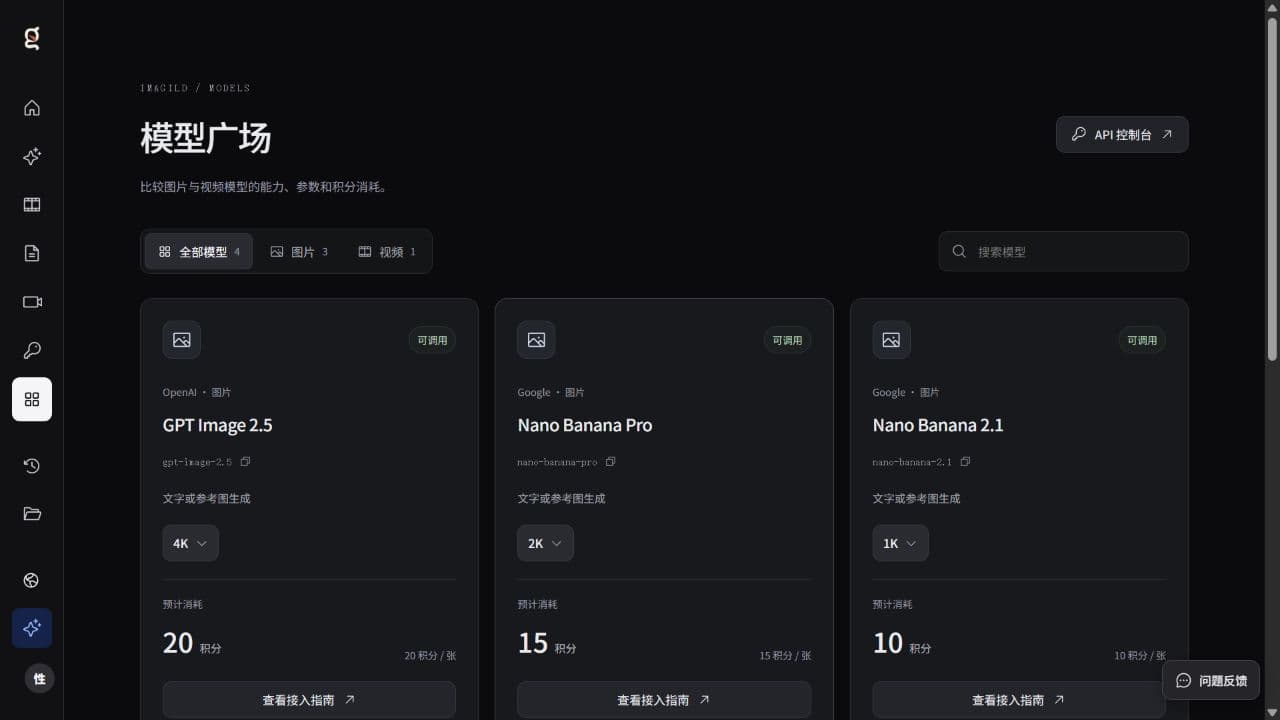
Cover: Original Imagild product screenshot captured on 28 October 2026; model availability and prices may change. This image is not an API response or a performance benchmark.