No. Revoking an Imagild API key disables that credential; it is not a command to delete generated media, cancel accepted tasks or remove copies already downloaded elsewhere. Treat credential lifecycle, task lifecycle and data handling as separate operations. The current public model API does not expose a media-deletion or generation-cancellation endpoint.
Key Takeaways
- A revoked credential should no longer authorize API requests.
- Accepted work and saved task identities must not be erased from your application's history.
- Deleting a local copy or requesting account-data handling is a separate workflow.
Identify which action the user actually wants
A user may mean “stop this integration,” “stop a pending video,” “remove a published picture” or “delete my account's stored material.” Revoking a key addresses only the credential part.
The Imagild API console provides key management and describes active-membership access. Its model API routes cover discovery, upload, generation, status and authenticated content retrieval. Do not invent DELETE /tasks/{id} or imply that a failed future authentication request proves previous media is gone.
Keep the lifecycle effects separate
| Action | What it establishes | What it does not establish |
|---|---|---|
| Revoke a key | That credential loses access | Accepted generation was cancelled |
| Let membership expire | API eligibility is no longer active | Stored results were deleted |
| Stop a local monitor | Your application stops checking | Provider execution stopped |
| Delete a downloaded copy | That chosen copy is removed | Other copies or account data disappeared |
| Remove a public derivative | That publishing destination changed | The source task ceased to exist |
This table is a decision aid, not a statement about an undisclosed storage-retention schedule. Do not infer perpetual access or a guaranteed deletion deadline from a key action.
Preserve accepted work during credential changes
Before an orderly credential replacement, retain operation IDs, task IDs and submitted parameters in protected storage. After revocation, requests using the old key fail authentication. A new valid key under the same account can be used for permitted existing-task access while membership remains active.
Do not start another generation merely to test whether the old result still exists. Use the task record and authorized read path. The failed-job checks help distinguish access failure from generation failure.
OWASP's secrets-management guidance treats secret rotation and revocation as credential lifecycle concerns. That general distinction does not supply Imagild-specific data deletion guarantees.
Handle application copies deliberately
Inventory where your own application stored original downloads, resized derivatives, published pages and export archives. A service key cannot recall bytes already copied to those destinations.
If the user requests removal from your application, apply its actual owner-authorized data workflow and record the result. Do not report that a remote account has been purged unless the relevant service has confirmed that action.
For a remote account-data request that the current API does not implement, use the site's published support path and obtain a specific response. Avoid promising timelines or compliance outcomes that are not documented.
Verify the effect you are claiming
Test credential rejection with a local mock, and separately test recovery of an existing task record using a replacement credential configuration. Do not make a paid generation solely to exercise revocation behavior.
For media removal, verify the particular publishing destination or local storage change instead. For access errors, inspect status and content type; the download troubleshooting guide helps avoid confusing an error response with lost media.
Pass the workflow when the UI names the actual action and reports only its demonstrated effect. A message such as “key revoked” is accurate after revocation; “all generated media deleted” requires separate evidence that the credential change cannot provide.
Related tasks
- What Should You Check Before Retrying a Failed Image or Video Job?
- Why Does My Downloaded Image Open as a Web Page?
Sources and scope
- Imagild API console: Actual model API authentication, membership, task ownership, supported routes and private media retrieval.
- OWASP Secrets Management: Rotation and revocation manage credentials; the article does not infer media deletion from those operations.
Product instructions were checked against the current Imagild API contract and the public model catalog. Code, budgets and acceptance checks are illustrative; this article does not claim a new paid generation test, an uptime measurement, a search-volume study or a ranking of AI citations.
Prepared by Imagild Editorial, the company editorial team responsible for these guides. AI assisted research and drafting. This is documentation-based guidance with proposed examples, not a claim of hands-on testing or an independent product review. Report a correction.
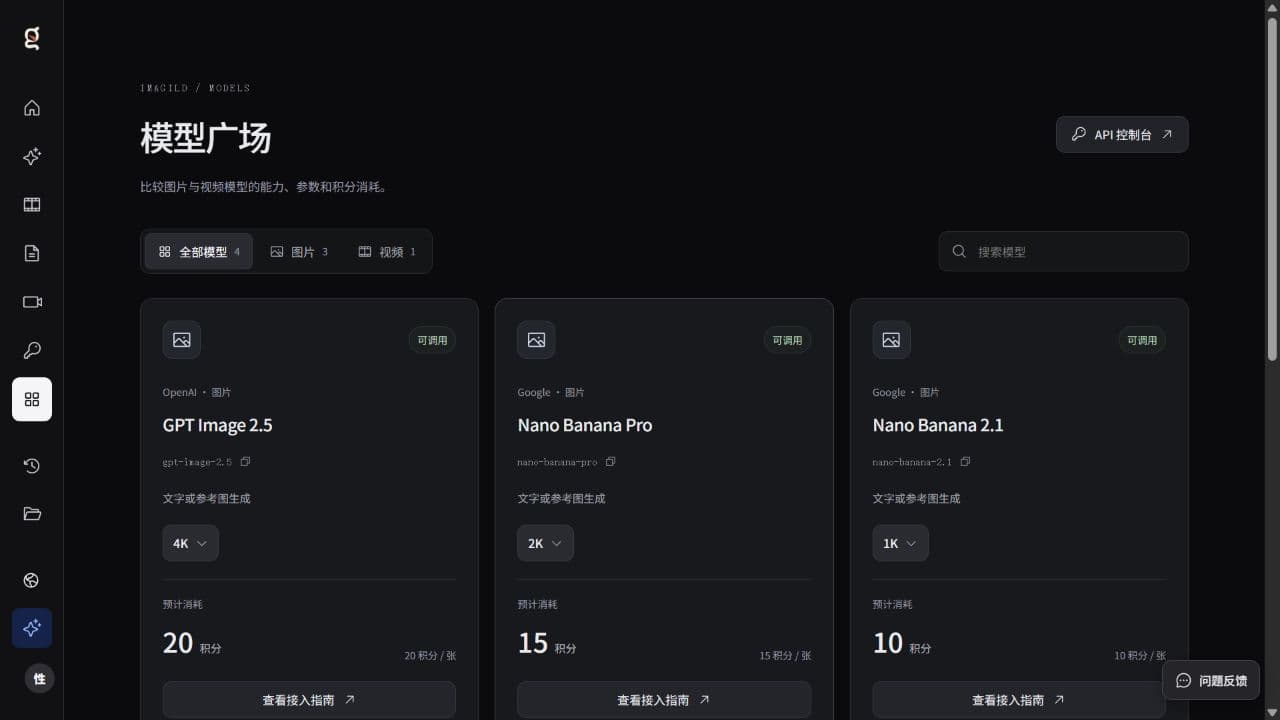
Cover: Original Imagild product screenshot captured on 28 October 2026; model availability and prices may change. This image is not an API response or a performance benchmark.