Reserved points are held for an unfinished Imagild operation; consumed points belong to completed successful generation; released points return a confirmed failed operation's reservation to availability. Read the task's usage state alongside its generation status. The number in usage.points is not, by itself, a new debit on every status request.
The Imagild API console exposes task-level usage through authenticated reads. Your application should translate that record accurately rather than displaying every nonzero quote as money already spent.
Key Takeaways
- A reservation temporarily reduces what remains available for other work.
- Consumption and release are alternative outcomes of a reservation, not two successive charges.
- A point release is not a promise of a cash refund to the payment method.
Follow one reservation through two possible outcomes
Imagine an account with 100 available points and no other activity. A 4K image has a 20-point quote.
| Observation | Available points | Reserved points | Consumed by this task |
|---|---|---|---|
| Before submission | 100 | 0 | 0 |
| After a 20-point reservation | 80 | 20 | 0 |
| If generation succeeds | 80 | 0 | 20 |
| Alternatively, if confirmed failed and released | 100 | 0 | 0 |
The last two rows describe different branches. They are not a timeline in which a successful image later receives an automatic release. Other website and API tasks can change the real account balance, so these numbers are an isolated illustration.
A local timeout is absent from this table because it does not establish either final branch.
Interpret the task record rather than reconstructing a wallet
A status response can include:
{
  "data": {
    "id": "11111111-1111-4111-8111-111111111111",
    "status": "failed",
    "usage": { "points": 20, "state": "released" }
  }
}
This reduced example is not a real ID to query. Twenty points describe the task amount; released says the reservation has been released. It does not mean the customer should subtract twenty more points from a local balance.
Another possible state is not_reserved, for example before initialization has established a reservation. Treat it as a different condition from released. Neither state proves a playable output exists.
There is no public relay wallet-balance endpoint in this contract. Do not invent GET /balance or assume that usage contains the customer's complete account ledger.
Display status and usage as two related facts
A waiting task with reserved points can read “Generating; 20 points reserved.” A succeeded task with consumed points can read “Completed; 20 points used.” A confirmed failed task with released points can read “Generation failed; reservation released.”
For an unknown video outcome, display that the result needs review and show the actual usage state. Do not turn uncertainty into an immediate release merely to simplify a dashboard.
Runware's pricing documentation distinguishes returned generation costs from account payment management. Imagild's point states and membership requirement remain its own contract, not an implementation of another provider's billing policy.
Reconcile by task identity
Save one row per Imagild task ID. Refreshing the same status response should update that row, not append another charge. Include your operation ID, quoted points, latest remote status, usage state and observation time.
If a response is unavailable, retain the last known state and mark the observation as stale. If a task appears failed but its point state needs clarification, keep the evidence and use the failed-job review checklist. Do not patch account balances on the client.
Test the numbers before showing them to customers
Feed your interface the four rows of the isolated example and confirm that a status refresh never spends another twenty points. Test unknown and not_reserved too, ensuring neither is presented as completed media.
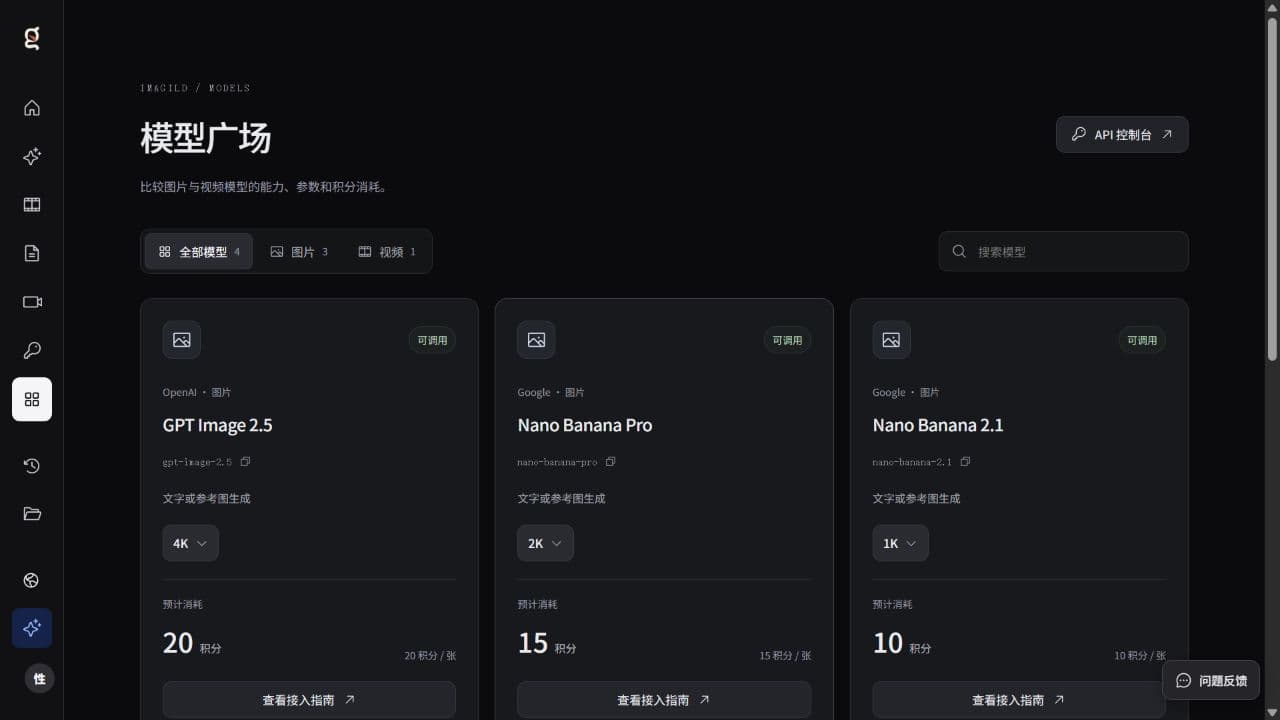
Current image tiers remain 10, 15 and 20 points, explained in the points and image-cost guide. Active membership determines API eligibility separately. A clear state model explains temporary availability without promising a cash refund, a refund deadline or additional free generations.
Related tasks
- What Should You Check Before Retrying a Failed Image or Video Job?
- How do Imagild points work for photos and video?
Sources and scope
- Imagild API console: Current active-member access, generation contract and per-task usage fields, independently cross-checked in lib/relay and claims.json dated 2026-10-28.
- Imagild model hub: Current image 10/15/20-point tiers, H3 duration/resolution rates and five-point enhancement option; not a quality or comparative availability benchmark.
- Runware Pricing: General distinction between configuration-based generation pricing, per-request cost and account payment management. Runware-specific fields, features and policies are not attributed to Imagild.
Product instructions were checked against the current Imagild API contract and the public model catalog. Code, budgets and acceptance checks are illustrative; this article does not claim a new paid generation test, an uptime measurement, a search-volume study or a ranking of AI citations.
Prepared by Imagild Editorial, the company editorial team responsible for these guides. AI assisted research and drafting. This is documentation-based guidance with proposed examples, not a claim of hands-on testing or an independent product review. Report a correction.
Cover: Original Imagild product screenshot captured on 28 October 2026; model availability and prices may change. This image is not an API response or a performance benchmark.