Test throttling behavior with a local fake transport and controlled clock instead of submitting paid image requests until a live account hits its limit. You can verify retry timing, operation identity, queue behavior and user messages without generating media. A fixture test validates your client logic; it does not measure Imagild's production capacity or availability.
Key Takeaways
- No API key or real generation is required for local 429 fixtures.
- Check dispatch timestamps and saved identities, not only the final response.
- Keep live smoke checks bounded and separate from client load simulation.
Replace transport before testing the scheduler
Design the client so its HTTP transport, clock and wait mechanism can be injected. A test can then return predefined responses and advance virtual time without sleeping for a real minute.
The Imagild API guide states the current account budgets and retry behavior. The gateway currently sends Retry-After: 60 on 429. Use that contract in a fixture, but do not call the fixture proof that all deployments enforce one globally consistent distributed counter.
Here is a small in-memory transport fixture using standard JavaScript Response objects. It makes no network calls:
const replies = [
  new Response(JSON.stringify({
    error: { code: "RATE_LIMITED", request_id: "local-fixture-01" }
  }), { status: 429, headers: { "Retry-After": "60" } }),
  new Response(JSON.stringify({
    data: { id: "fixture-task", status: "queued", poll_after_seconds: 5 }
  }), { status: 202 })
];
const calls = [];
const fakeTransport = async operation => {
  calls.push(structuredClone(operation));
  const reply = replies.shift();
  if (!reply) throw new Error("Unexpected extra request");
  return reply;
};
Pass this function into your own adapter's test interface. fixture-task is intentionally a local test marker, not a valid production UUID or a task you can retrieve. A test clock and your client under test must be supplied separately.
Assert the timeline and the unchanged operation
Create one saved operation with a stable key and payload. Start it at virtual time zero, return the 429 and inspect the client's next eligible attempt. Advance the test clock to just before sixty seconds: the second dispatch must not have occurred.
Advance beyond the allowed delay and let the retry proceed. Assert that the two captured operations have the same idempotency key and identical parameters. A changed key is a failure even if the second fixture returns acceptance.
MDN's Retry-After reference documents the delay's meaning. Your application's retry budget and jitter policy should preserve that minimum rather than shorten it.
Exercise failures beyond one successful retry
Use separate cases with explicit expected outcomes:
| Fixture | Required client behavior |
|---|---|
| Second response is also 429 | Extend or defer recovery within its retry budget |
| Two workers share one account | Coordinate the affected request-class cooldown |
| Status read is throttled | Preserve the last known task; do not resubmit generation |
| Task reports unknown | Keep identity and route to reconciliation |
| Worker restarts during cooldown | Recover its deadline and operation from durable storage |
The Node test runner documents test and mocking facilities for JavaScript applications. Use the facilities supported by your runtime, or inject a simple test clock directly. None of these cases requires a paid image.
Keep rate tests separate from media correctness
A local fixture cannot prove that a model creates correct text, a video plays cleanly or a download contains valid media. Those need their own bounded functional checks. Conversely, a single beautiful output says nothing about how your scheduler behaves under 429.
If a later approved smoke check produces a real task, preserve its task ID and inspect the existing result rather than regenerating it to exercise the client. The failed-job guide and download troubleshooting guide help separate these failure classes.
Record the evidence your test actually supports
Report the fixture cases passed, the client version, maximum simulated in-flight requests and the recovery assertions. Do not advertise an uptime percentage or provider throughput figure from this evidence.
Accept the test suite when unexpected extra sends fail visibly, restart recovery preserves identities and no test can reach production transport accidentally. Keeping local fixture credentials empty and production configuration unavailable makes that boundary reviewable while protecting both the account budget and real users' work.
Related tasks
- What Should You Check Before Retrying a Failed Image or Video Job?
- Why Does My Downloaded Image Open as a Web Page?
Sources and scope
- Imagild API console: Current request limits, retry handling, authentication and asynchronous task lifecycle.
- MDN Retry-After header: The retry delay should not be shortened by a client's wait or jitter policy.
- Node.js test runner documentation: Local test and mocking facilities for application fixtures; not production capacity measurement.
Product instructions were checked against the current Imagild API contract and the public model catalog. Code, budgets and acceptance checks are illustrative; this article does not claim a new paid generation test, an uptime measurement, a search-volume study or a ranking of AI citations.
Prepared by Imagild Editorial, the company editorial team responsible for these guides. AI assisted research and drafting. This is documentation-based guidance with proposed examples, not a claim of hands-on testing or an independent product review. Report a correction.
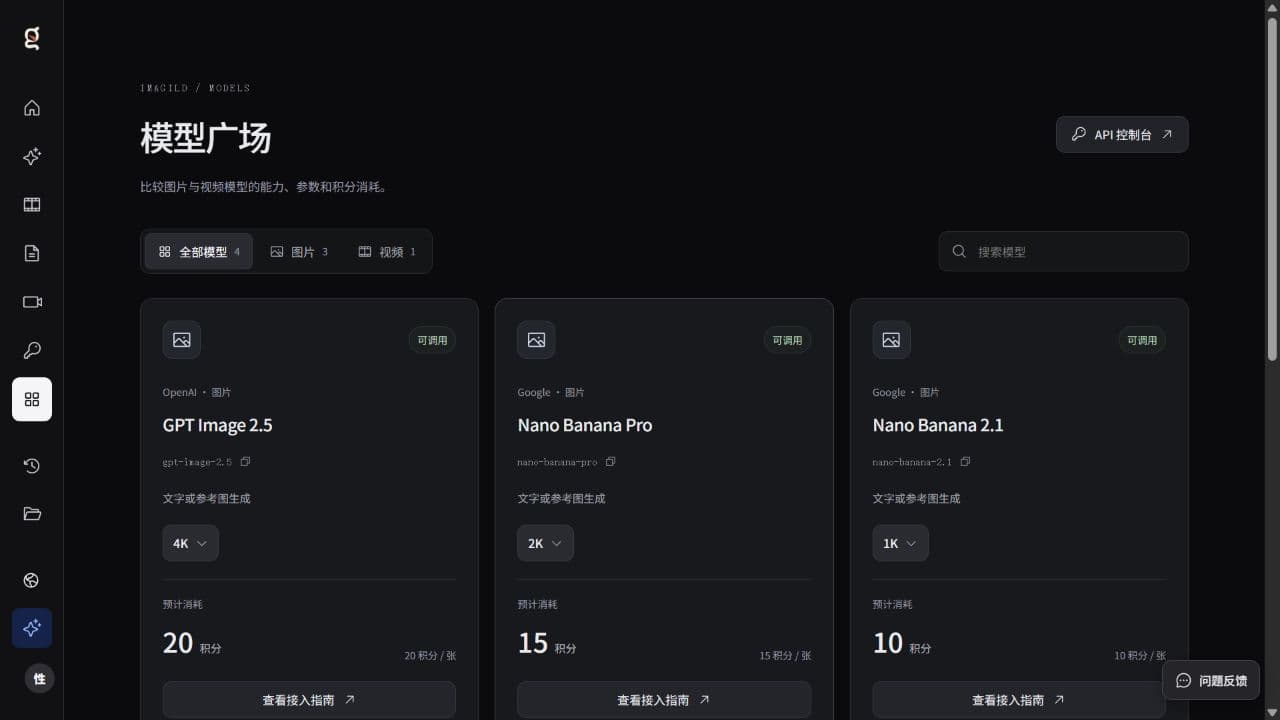
Cover: Original Imagild product screenshot captured on 28 October 2026; model availability and prices may change. This image is not an API response or a performance benchmark.