Schedule an image-to-video graph by storing dependencies in your application and dispatching each node only after its required source has succeeded. Imagild accepts individual image and video tasks; your application owns the graph, approvals, scheduling, and any final assembly. Do not send a graph object to a nonexistent workflow endpoint.
Key Takeaways
- Every paid node has its own immutable request, operation key, and returned task ID.
- Child video requests bind to a completed owned image through
image_task_id.- Retry a stage by its evidence; do not restart successful ancestors automatically.
Draw the intended dependency before submission
Consider one approved image feeding two short video candidates:
| Application node | Dependency | Planned request | Points |
|---|---|---|---|
| Source image | None | 1K image | 10 |
| Clip A | Approved source image | H3, 4 seconds, 768P, IR off | 60 |
| Clip B | Approved source image | H3, 4 seconds, 768P, IR off | 60 |
| Review/assembly | Approved completed clips | Application or external editor | Separate application cost |
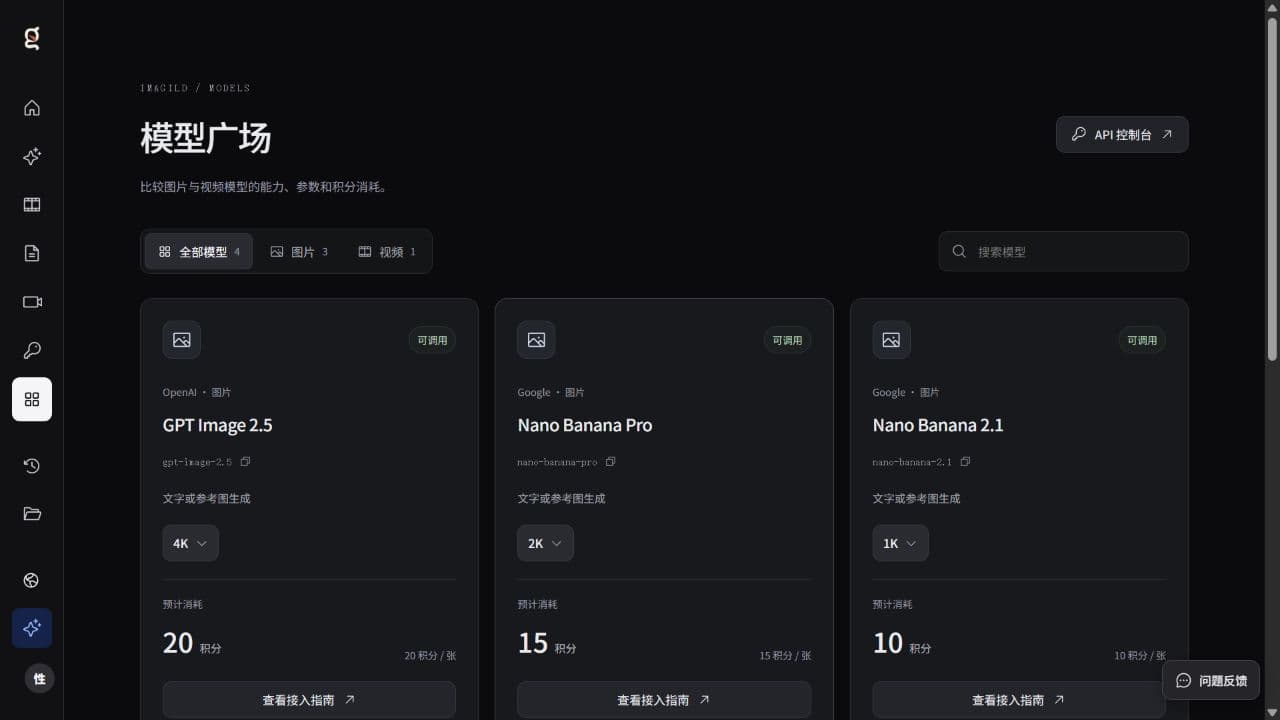
The planned generation allocation is 130 points, excluding retakes and separate storage/editing costs. Check the model market before approval. API use requires active membership independently of points.
The last row is not an Imagild long-film API endpoint. It marks work your application must perform using approved outputs.
Keep graph metadata outside generation JSON
A node record can contain an application ID, dependencies, approval state, operation key, request snapshot, task ID, and observed outcome. Fields such as dependencies, node_id, and approved_by belong in your database, not in strict generation requests.
The API console defines each individual task contract. After the source image succeeds and remains available, the child payload selects MiniMax-H3, its supported video settings, and the parent's image_task_id. Do not also supply file_id.
Persist the resolved source task ID into the child request before dispatch. If a source selection later changes, create a new approved child plan rather than mutating an accepted request.
Separate readiness from dispatch ownership
This JavaScript helper finds candidates in an application graph. The local states are illustrative, not a new API enum:
function readyNodes(nodes) {
  const byId = new Map(nodes.map(node => [node.id, node]));
  return nodes.filter(node =>
    node.localState === "planned" &&
    node.approved === true &&
    node.dependencies.every(id =>
      byId.get(id)?.localState === "succeeded"
    )
  );
}
Validate missing dependencies and cycles before scheduling. A readiness list is not a lock: use your database's transaction or lease policy to claim a node, persist its remote operation identity, and prevent concurrent workers from inventing different keys for the same approval.
Runware's polling documentation illustrates the distinction between asynchronous acceptance and later outcome retrieval. Its delivery mechanisms and fields are not automatically available in Imagild.
Stop dependency propagation on failure
If the source image fails, hold both clips and show the source issue. If Clip A succeeds while Clip B fails, preserve Clip A and inspect only Clip B's operation. An unknown child outcome should remain unresolved rather than becoming permission to rerun the whole graph.
For a lost acknowledgment, recover the same node with its original key and parsed parameters. For a deliberate new creative attempt, make a new node revision and quote it separately. Remote duplicate protection does not prove global exactly-once behavior across a scheduler and editor.
Verify media continuity after task success
A dependency edge establishes input flow, not creative continuity. Review each clip's subject, framing, action, first frame, and ending. A shared source does not guarantee seamless motion between independently generated clips.
The first-frame motion guide helps assess starting action. Use the failed-job guide when choosing a targeted correction.
A useful graph acceptance test simulates parent failure, successful source approval, two ready children, a duplicate scheduler delivery, and partial child completion. Confirm identities and budgets from records. These are proposed tests, not a claim of new paid end-to-end generation or automatic long-video continuity.
Related tasks
- How Can My AI Clip Start in Motion Instead of Spending Seconds Accelerating?
- What Should You Check Before Retrying a Failed Image or Video Job?
Sources and scope
- Imagild API console: Individual async tasks, owned completed image reference and strict image/video schemas.
- Imagild model market: 130-point example:10+60+60 under current image/H3 prices withIRoff.
- Runware Task Polling: Async task acceptance and outcome retrieval are distinct scheduler stages.
Product instructions were checked against the current Imagild API contract and the public model catalog. Code, budgets and acceptance checks are illustrative; this article does not claim a new paid generation test, an uptime measurement, a search-volume study or a ranking of AI citations.
Prepared by Imagild Editorial, the company editorial team responsible for these guides. AI assisted research and drafting. This is documentation-based guidance with proposed examples, not a claim of hands-on testing or an independent product review. Report a correction.
Cover: Original Imagild product screenshot captured on 28 October 2026; model availability and prices may change. This image is not an API response or a performance benchmark.