
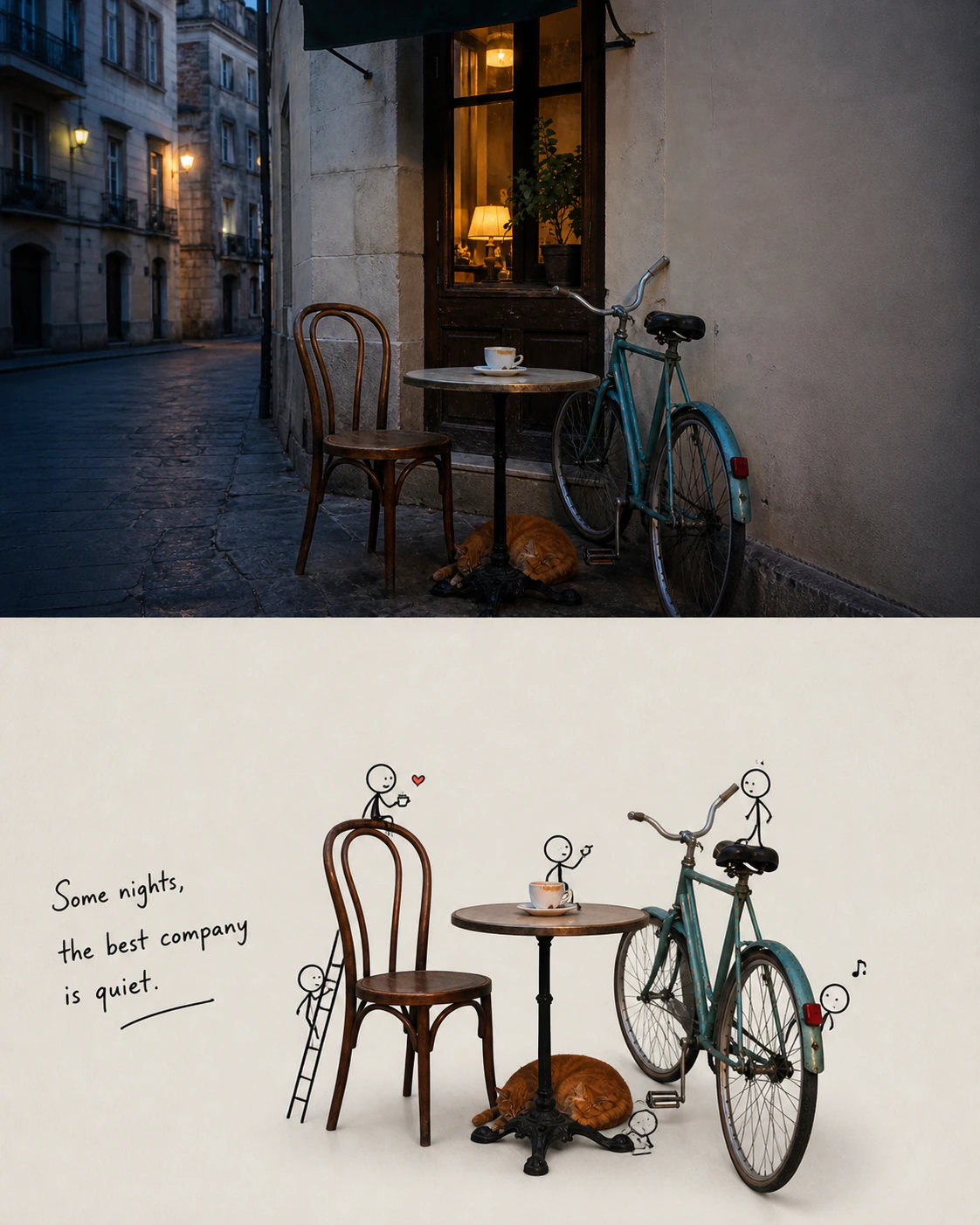
Choose a photo Skill whose example solves a similar visual problem to your own image. Compare the source and result, identify which details survive, and decide whether the transformation suits your destination. Likes help discovery, but they are not evidence that a method will work well on every upload.
Read the input before admiring the output
A beautiful result from a simple mountain photograph does not tell you how the same method handles a crowded family portrait. Compare the number of subjects, their size, overlap and background complexity. An example with one large object is a more relevant reference for a product-like still life than a distant skyline.
Write down three visual anchors in your photo. They might be a dog’s ear shape, the position of a chair and the warm window light. Decide which must remain recognizable and which may be simplified. This makes your choice accountable to the source rather than to a fashionable style name.
Distinguish three kinds of transformation
| Transformation | What to inspect | What not to assume |
|---|---|---|
| Surface treatment | Color, grain and preserved shapes | Every pixel stays untouched |
| Illustrated reconstruction | Subject count and recognizable structure | Fine text survives accurately |
| Editorial layout | Crop, reading order and margins | The file includes editable layers |
The categories are review aids, not a technical description of every Skill. A generative method can combine them and may invent detail even when the brief asks for restraint.
Run a controlled first test
- Save the unedited source and note your three anchors.
- Select a method with a composition similar to yours.
- Add only the image-specific detail that matters.
- Check the result against the source before evaluating decoration.
- Save an approved version with the method and resolution in your notes.
An illustrative image-specific addition:
Keep the dog's uneven ear silhouette and collar recognizable. Simplify the garden rather than adding new toys. Leave a quiet margin for a caption added later.
This is more useful than a long list of unrelated aesthetic adjectives. It is a suggested brief, not a tested result guarantee.
Compare methods without changing the question
Use the same source and the same preserve list when comparing two methods. If you change the source, pose and desired format simultaneously, you cannot tell which decision improved the result. Record whether a rejection came from identity, composition, unwanted objects or output suitability.
For critical faces or logos, a rejected result is not redeemed by good texture. If the task is documentary, ordinary editing may be more appropriate than a visual reconstruction.
Google's people-first content guidance emphasizes useful, trustworthy information rather than content made primarily for search traffic. Applied here as an editorial principle, a specific example and an honest limitation are more useful than a universal “best effect” claim.
Common questions
Should I always choose the most-liked Skill?
No. Popularity can suggest what to inspect first, but your source and intended use should decide what you apply. Likes are not a controlled performance benchmark.
Is the preview a guarantee?
No. It shows a particular result. Compare your own output, especially faces, hands, signs and small repeated objects. Browse Image Skill Market and keep the original available throughout review.